





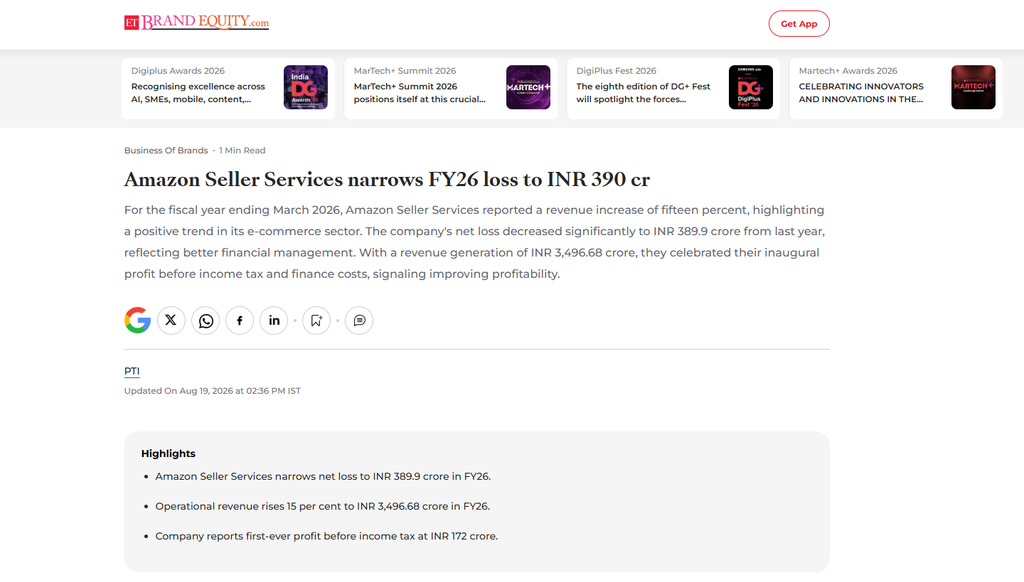
Amazon’s India business has recently shown an important change. In the fiscal year ended March 31, 2026, Amazon’s India seller services business increased its operating revenue by about 15% to approximately INR 34.97 billion. More importantly, the business reported its first positive profit before tax and finance costs, at around INR 1.72 billion. However, it still recorded a net loss of approximately INR 3.90 billion for the year.
This does not mean Amazon India has become fully profitable. Instead, it shows that after years of investment, its operating efficiency is beginning to improve. For Amazon, this is an important business signal. For overseas sellers, it also points to a broader change: India’s ecommerce market is gradually placing more emphasis on cost control, fulfillment efficiency, and real profitability.
Over the past decade, Amazon has continued investing in logistics, customers, and market development in India, while the country’s ecommerce market has expanded rapidly. The improving profitability of the platform does not mean opportunities in India are disappearing. It means that relying solely on low prices, constant advertising, and high sales volume is becoming less effective for generating sustainable profits.
India is still worth watching, but sellers need to rethink how they operate. Going forward, the key will not simply be who lists the most products. It will be who can choose products more precisely, calculate costs more clearly, control inventory better, and adapt products to local Indian demand.
Product Selection: Stop Copying Western Bestsellers and Start With Local Demand
Many sellers entering India simply bring products that are already successful in the US or European markets. But consumer purchasing power, usage scenarios, and buying habits can vary significantly between markets. A product that sells well in Western markets does not automatically have the same potential in India.
For small and mid-sized sellers testing the Indian market, it may be safer to avoid several categories at first: high-priced non-standard products, non-essential decorative products, overly complicated products, fragile goods, bulky items, and products with high after-sales costs.
These products are not impossible to sell. However, they generally require more capital and stronger operational capabilities, making them less suitable for sellers who are still testing the market.
When choosing products, start with five characteristics: essential, durable, lightweight, low-maintenance, and easy to understand.
Products that people use regularly, are unlikely to break, have low transportation losses, and do not require complicated customer support are generally easier to manage.
In terms of pricing, sellers can initially test products priced around INR 300 to INR 800. This range can provide room to balance consumer acceptance, platform fees, delivery costs, and potential return losses. Products priced below INR 200 require more caution because fixed fulfillment costs can represent a larger share of the selling price, leaving very little room for profit.
It is also worth watching the development of quick-commerce in India and related demand for frequently purchased small items, such as household consumables, small home products, personal care products, and simple kitchen tools.
The goal, however, should not be to immediately find “the next bestseller.” Instead, look for products with clear demand, frequent use, and relatively simple after-sales requirements. These products may not become overnight hits, but they can be easier to manage from a long-term profitability perspective.
Before launching a product, do not simply copy conclusions from Western markets. A more practical approach is to look at India first, then compare it with Western markets. Start by checking local competitors, their prices, customer reviews, and negative feedback. Data from other markets can then be used as a reference.
Sellers who need additional market validation can also use residential IPs and data collection tools to view product prices, competitor performance, and consumer demand from a local perspective. For example, NovProxy provides capabilities related to market research and price monitoring, which can help sellers collect public market information from different regions during the product selection process.
Ultimately, what determines whether a product can make money in India is not how well it sells in the US or Europe. It is how much Indian consumers are willing to pay and what problems existing products have yet to solve.
Pricing and Profitability: Stop Focusing on Sales and Calculate Real Profit
After years of investment, Amazon India is beginning to show improvements in operating efficiency. One important takeaway is that cost control and profitability are becoming increasingly important. The same principle applies to small and mid-sized sellers.
Scale matters, but scale must be built on sustainable profit.
Many sellers calculate profit by looking only at the difference between the selling price and product cost. The numbers may look attractive at first, but after the monthly accounts are settled, advertising, delivery, and returns can easily consume most of the margin.
For this reason, sellers should not judge profitability based on product markup alone. Real net profit should account for product costs, platform fees, delivery costs, advertising expenses, return losses, and taxes.
For small and mid-sized sellers, a 20% after-tax net profit margin can be used as an internal target. This is not an industry-wide standard for India, but rather a practical benchmark for evaluating products.
If a product consistently fails to meet the target, do not continue supporting it simply because you have already invested money in advertising, inventory, and operations. Reducing investment or removing low-margin products can free up capital for products with stronger potential.
There are three costs that deserve particular attention.
First, return-related losses.
Some categories have relatively high return or refusal risks, especially apparel, experience-based products, and products where the actual experience may differ from customer expectations. Looking only at the profit from completed orders can easily lead to an overly optimistic estimate.
Second, last-mile delivery costs.
The lower the selling price, the larger the share of revenue that delivery costs can represent. A low-priced product that generates orders easily is not necessarily a profitable product.
Third, ongoing advertising costs.
If a product relies heavily on advertising to maintain sales, growing revenue does not necessarily mean growing profit. Advertising should help sellers identify effective demand rather than permanently replace the product’s own competitiveness.
It is worth conducting a weekly product profitability review, checking sales, advertising spending, returns, fulfillment costs, and final profit.
Products can then be divided into three simple groups. Profitable products can receive continued investment and gradual expansion. Low-margin products should be improved through pricing, cost, or advertising adjustments. Products that remain unprofitable or consistently underperform should be removed from further investment.
When operating in India, sellers need to change one old habit:
Instead of asking “How many units can this product sell?”, ask “How much can I actually earn from each sale?”

Market Entry: Test With Limited Investment Before Scaling
India’s ecommerce logistics and quick-commerce sectors are continuing to develop, creating new opportunities. But that does not mean small and mid-sized sellers should immediately make large investments.
The Indian market still involves uncertainties related to regulations, taxes, consumer habits, and fulfillment. For most sellers, a more cautious approach is to test whether a product can generate stable profits before pursuing scale.
Start with a limited number of products, smaller inventory levels, and controlled budgets. Observe actual sales and profitability before deciding whether to increase investment.
Do not immediately stock large quantities simply because a competitor’s product is gaining traction. Once a popular product attracts more sellers, competition can increase quickly. By the time the market data becomes obvious, both entry costs and competitive pressure may already be higher.
New sellers also do not need to build a complicated logistics system from the beginning. They can rely on established warehousing and fulfillment services and gradually adjust inventory based on actual sales, inventory turnover, and delivery costs.
The key principle is simple: before a product has been validated, avoid putting too much capital into inventory and logistics.
Traffic acquisition also needs to evolve.
A common strategy in the past was to use low prices to generate volume and then spend heavily on popular keywords. For sellers with limited budgets, it is more practical to start with precise customer demand.
Focus on scenario-based and long-tail search terms with clear purchase intent. Use a limited budget to test clicks and conversions, then gradually increase spending on keywords that consistently generate both orders and profit.
The goal is not to completely avoid competition. It is to identify a profitable niche first and then gradually expand.
At the same time, sellers can continue monitoring consumer demand created by quick-commerce. High-frequency, small, easy-to-deliver products with clear immediate-use scenarios are worth watching. But sellers should not enter a category simply because it is being discussed as a growth opportunity. Consumer demand and actual profitability should remain the final criteria.
4 Common Mistakes New Sellers Should Avoid
1. Avoid Complicated Non-Standard Products
Fragile products, complicated products, and items that require extensive customer support can significantly increase operating and fulfillment costs. For sellers new to India, simple, durable, and easy-to-understand products are generally easier to manage.
2. Do Not Blindly Chase Trending Products
Once a popular product attracts large numbers of sellers, competition can increase rapidly. Seeing another seller’s sales surge does not mean the same strategy can still be replicated.
Study bestsellers, but do not simply copy them.
3. Do Not Depend on Low Prices for Too Long
Low prices can generate orders, but they do not automatically generate profits. If a product leaves very little profit on every order, increasing sales can actually increase financial pressure.
4. Do Not Copy Western Operating Models
Once a product enters the Indian market, its pricing, packaging, product-page messaging, and even product features may need to be adjusted for local consumers.
Real localization is not simply translating a product page. It means understanding why Indian consumers buy the product, what they care about, and what existing products still fail to address.
Conclusion: India Still Has Opportunities, but the Profit Equation Is Changing
The improvement in Amazon India’s operating profitability does not mean opportunities in the Indian market are disappearing. Instead, it suggests that the market is becoming increasingly focused on cost, efficiency, and profitability.
For small and mid-sized overseas sellers, entering India does not require large inventory commitments from day one, nor does it require relying on heavy advertising spending to create impressive sales numbers.
What matters more over the long term is finding products that match local demand, calculating the real profit of every transaction, controlling inventory and fulfillment costs, and increasing investment based on actual results.
The competition in India may no longer be about who lists the most products or offers the lowest price. It may increasingly come down to who can choose better, calculate more accurately, and operate more efficiently.
Forget the idea that one successful bestseller can make you rich overnight. Use small-scale testing to collect real market data, then use refined operations to scale products that have already been validated. For ordinary overseas sellers, that is likely to be a more sustainable way to approach the Indian market.