





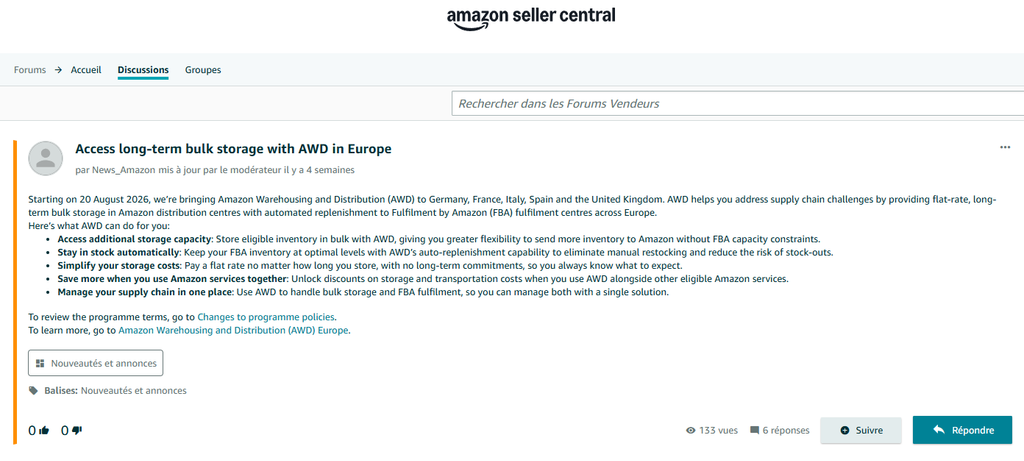
On August 20, 2026, Amazon Warehousing & Distribution (AWD) officially went live across five European marketplaces: the United Kingdom, Germany, France, Italy and Spain. Having proven its reliability in the US, this launch marks a substantial upgrade to Amazon’s European fulfilment infrastructure. For Chinese sellers operating in Europe, it represents more than an additional warehousing option — it delivers meaningful opportunities to refine Q4 peak season preparation and inventory turnover strategies.
Late August kicks off the preparation cycle for Europe’s Black Friday and Christmas sales events. European sellers have long grappled with a classic peak season dilemma. Shipping large volumes directly to FBA upfront can lead to overstock and capital lock up if sales fall short of projections. Conservative stocking, by contrast, may trigger stock outs during demand surges, dragging down product rankings and organic traffic. While AWD cannot eliminate inventory related risks entirely, it grants sellers greater stocking flexibility and eases the persistent trade off between stock outs and overstock.
AWD Complements FBA to Build Critical Inventory Buffers
Many sellers misinterpret AWD as a replacement for FBA. In reality, the two services serve separate yet complementary purposes. FBA functions as the customer-facing fulfilment warehouse, handling order delivery, after-sales support, and Prime-eligible active inventory. AWD sits further upstream within the supply chain, holding bulk reserve stock. It automatically replenishes FBA based on real-time marketplace sales, creating a connected workflow between reserve storage and order fulfilment warehouses.
Multi-marketplace European operations have historically created notable stocking challenges. The five markets differ in market momentum, promotional calendars, and consumer demand. Planning FBA stock per individual marketplace frequently results in stockouts in high-demand regions while other sites carry excess inventory. Shipping all goods directly into FBA ties up large amounts of capital and leaves little room for later adjustments.
AWD transforms this operating model. Sellers can store large volumes of peak season inventory as reserves within AWD, while maintaining only day-to-day sellable stock in FBA. The system feeds inventory into FBA in staggered batches according to actual sales performance. The old high-risk “one and done stocking” approach evolves into demand-driven phased deployment. This secures supply for peak periods and greatly reduces risks stemming from mass overstock.
Addressing Core Q4 Pain Points: Mitigating Forecasting Shortfalls
Q4 generates Europe’s highest annual sales volume and creates the heaviest inventory management pressure. Under conventional workflows, sellers must forecast demand, secure stock, and ship goods to FBA months ahead of sales. Accurate forecasts unlock full peak season revenue potential. However, cooling market sentiment can leave substantial volumes stranded in FBA, incurring steep storage and disposal fees and straining working capital. Understocking, meanwhile, forfeits peak period traffic and revenue.
AWD fits this peak season use case well. Sellers can pre-build sufficient peak season inventory and store bulk quantities in AWD without immediately forwarding everything to FBA. Replenishment volumes can later be adjusted dynamically in response to real-time sales, ad performance, and platform promotions. Inventory aligns closely with genuine market demand rather than subjective sales guesswork.
Important limitations apply. AWD improves stocking flexibility but does not remove risk. Transfers from AWD to FBA require processing and transit lead time; instant restocking is not possible. Sellers still need to calculate sales velocity and replenishment cycles, maintain safety stock levels, and avoid over-reliance on automated system workflows.
Identifying Suitable SKUs: Which Products Fit AWD and Which Should Avoid It
AWD is not a universal solution. It streamlines inventory management for stable demand products but cannot offset poor product selection or extreme sales volatility. Sellers should evaluate their catalog objectively before adopting the service.
Established, consistently popular items are the strongest candidates for AWD. These SKUs feature long-term sales track records, predictable peak season growth, and proven market demand. Sellers monitoring competitor pricing, product ranks, and public market data across diverse European markets may leverage IP tools such as NovProxy for overseas research to inform more robust inventory planning.
New launches, short-lived trending goods, and strictly seasonal products call for caution. New items lack historical sales benchmarks and carry highly uncertain demand. Even stock held within AWD consumes capital and can turn into dead inventory if market reception disappoints. Trending and seasonal goods feature compressed selling windows and fast-shifting trends. A light inventory, fast turnaround operating mindset is recommended; aggressive pre-stocking amplifies business risk.

Common Cost Calculation Pitfalls: Do Not Rely Solely on Per-unit Storage Rates
When assessing AWD, many sellers simply compare AWD and FBA storage fees. This narrow comparison produces misleading conclusions about overall profitability. Storage represents only one component of inventory costs. Total profit impact depends on end-to-end supply chain expenses and underlying risk exposure.
Full lifecycle inventory costs cover inbound freight, warehousing fees, cross-warehouse transfer charges, FBA fulfilment fees, capital opportunity costs, and obsolescence losses. Sending all stock straight to FBA delivers simple operations with no secondary transfer costs, yet capital remains locked for longer and risk becomes concentrated, with severe losses if items underperform. Tiered stocking via AWD introduces transfer expenses yet diversifies inventory risk, shortens capital tie-up cycles, and improves overall inventory health.
Effective evaluation centres on whether the model lowers total operating costs, boosts inventory turnover, and absorbs peak season volatility. Stable best sellers gain value that outweighs incremental transfer costs. Applying AWD to slow-moving, volatile SKUs will only increase financial pressure unnecessarily.
Operational Risk Control: Automated Replenishment Does Not Equal Hands-off Management
AWD automates replenishment workflows and cuts manual workload, yet it does not support fully unattended operations. Sales velocity shifts continuously under the influence of ad spend, platform promotions, seasonal cycles, and category trends, causing real-world performance to diverge from historical benchmarks. Blind trust in auto-replenishment creates two typical failure scenarios: delayed restocking and peak-season stockouts amid demand surges, or redundant inventory build-up when sales decline.
Sellers should continuously track sales volume, growth rates, ad conversion, and inventory turnover, proactively adjusting stocking and replenishment plans as market conditions evolve. Furthermore, local AWD inventory in Europe triggers strict VAT compliance rules. Sellers must secure valid tax registrations for relevant markets to align logistics setups with tax obligations. European AWD policies, pricing, and lead times differ from the US, so US-oriented operating playbooks cannot be copied directly.
Industry Outlook: AWD Will Not Replace Third-Party Overseas Warehouses
Since AWD rolled out in Europe, many sellers have questioned whether third-party overseas warehouses will become obsolete. Functionally, the two solutions complement rather than compete with one another.
Deeply integrated within Amazon’s ecosystem, AWD excels with FBA data synchronisation, automated transfers, and standardised procedures. It is optimised for bulk reserve stocking and peak season turnover for stable Amazon exclusive SKUs. Third-party overseas warehouses stand out for operational flexibility. They support Amazon stores, independent sites, multi-platform listings, and local consumer orders, suiting sellers running omnichannel businesses.
The most practical European fulfilment strategy today adopts multi-warehouse collaboration. Mature Amazon best sellers use AWD paired with FBA for granular inventory orchestration. Stock serving multiple sales channels or requiring flexible allocation goes to third-party warehouses, balancing compliance, efficiency, and cost.

Conclusion
Amazon AWD’s launch across five European markets is more than a new warehousing feature. It addresses long-standing peak season stocking pain points and resolves the familiar dilemma of choosing between overstock and stockouts. Tiered inventory architecture and flexible stock deployment make European stocking more predictable heading into Q4.
Sellers should avoid expanding inventory blindly simply because of this new service. Evaluate product stability, inventory turnover, cost structures, and compliance requirements before adopting AWD. Optimise inventory structures, unlock working capital, and mitigate operational risks. These steps build competitive advantages and underpin steady growth throughout Europe’s peak shopping season.