





Key Takeaways:
- The two new AI features in Google Ads, and the different roles of Gemini Omni and AI Max.
- How AI is moving beyond ad creation into ad testing, budget planning, and campaign decisions.
- How the latest AI updates may change advertising strategies and competitive priorities for international sellers.
- How sellers can use AI to improve efficiency while maintaining customer insights, market judgment, and data validation.
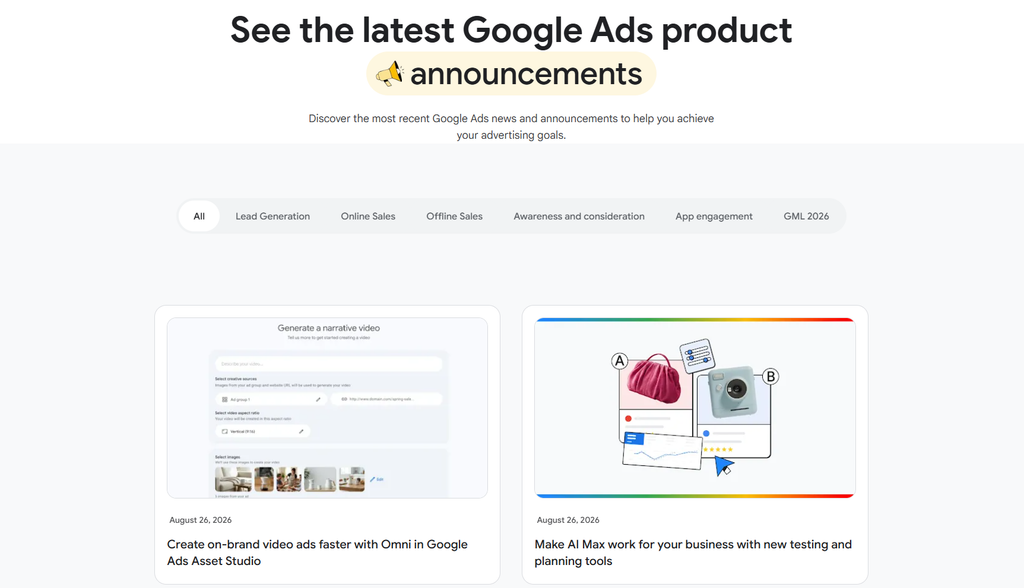
Google Ads recently announced two new AI updates. The first brings Gemini Omni to Google Ads Asset Studio, helping advertisers create branded video ads more efficiently. The second adds new testing and planning tools to AI Max, allowing advertisers to test different budget and ROI targets and evaluate the potential impact of campaign changes.
These updates are worth watching for global sellers. In the past, AI was mainly used to write product copy, create images, and organize data, while video production, campaign testing, and budget adjustments still required significant manual work. Google is now bringing AI deeper into the advertising workflow, from content creation to campaign testing and planning. AI is gradually moving from handling individual tasks to becoming part of the broader campaign process.
Gemini Omni Comes to Google Ads, Making Video Creation More AI-Driven
For many sellers, creating video content is not a simple process. From preparing product assets to developing scripts, scenes, editing, and producing different versions, a single video can involve multiple steps. When sellers need to continuously test new creative ideas across products and markets, the time and cost can increase quickly.
Google’s introduction of Gemini Omni to Asset Studio is designed to address part of this process.
Generate Video Assets Based on Brand Information
Businesses can bring existing brand guidelines and website information into Asset Studio and then provide a simple creative description. Gemini Omni can use this information to generate video storyboards and dynamic scenes.
Importantly, Google is focusing on more than simply generating videos. Asset Studio also takes brand visuals and language requirements into account to help keep generated content consistent with the brand. Google says Gemini Omni can understand the relationships between scenes and consider how subsequent scenes should develop.
For sellers, this means AI-generated content is not only about visual quality. It also needs to remain consistent with the brand. This can be particularly useful for brands that already have a defined visual identity and product positioning.
From Creative Ideas to Video, Reducing Manual Work
In the past, if a seller wanted to test multiple video concepts for a product, they typically had to prepare assets, develop scripts and scenes, and then edit each version separately. Every additional creative direction meant more production time.
Gemini Omni can start with a simple creative brief and generate video storyboards and scenes. Advertisers can then use natural language to make further changes, such as adjusting scenes, backgrounds, visual styles, voiceovers, pacing, and aspect ratios.
This means AI can assist not only with the initial creation but also with subsequent editing. For sellers who regularly test different creative concepts, the biggest benefit may not be eliminating video production altogether, but making the creation and revision process faster.
One Creative Idea Can Be Adapted to Different Formats
Campaigns often require different video formats and placements. Google says Gemini Omni can help advertisers generate video versions in formats such as 16:9 landscape and 9:16 vertical, with the resulting assets available for use in campaigns.
For sellers, this can reduce the need to repeatedly produce different versions manually. Once a creative concept has been validated, it can be adapted more quickly for different placements, making further testing more flexible.
Of course, AI-generated content should not automatically go live. Product details, language, localization, brand guidelines, and advertising compliance still need to be reviewed manually. When targeting different countries and markets, sellers should also make sure the generated content reflects local consumer preferences and the actual product.
AI Max Adds Testing and Planning Tools, Bringing AI Into Campaign Decisions

If Gemini Omni addresses how to create video assets, the latest AI Max update goes a step further by addressing how campaigns can be managed.
Google is adding new testing and planning capabilities to AI Max. Advertisers can test multiple Search campaigns and compare different budget and ROI targets within an A/B test. Google says this capability will begin rolling out in September 2026, helping advertisers better evaluate how scaling campaigns could affect business outcomes.
From Automated Optimization to Testing Different Campaign Strategies
Previously, advertisers would generally set their goals, let the system optimize based on actual campaign performance, and then adjust budgets and strategies based on the data. This approach still requires advertisers to wait for real-world feedback.
The new testing capability adds another step: testing a strategy before making a major change.
For example, a seller planning to increase the budget for a particular market could compare different budget and ROI targets instead of immediately changing the settings and waiting for new data. This does not mean AI can accurately predict the exact number of orders a campaign will generate. Rather, it gives advertisers another reference point before making a decision.
For small and mid-sized sellers with limited budgets, this can be particularly useful. The smaller the budget, the more costly a major adjustment can be. Testing strategies in advance may help reduce decisions based entirely on experience.
Performance Planner Helps Evaluate Budget and ROI Changes
Google has also updated Performance Planner. Advertisers can use the tool to see how changes to bidding or budget targets could affect existing campaigns and can apply recommended adjustments directly to campaigns.
For example, a seller launching a new product can first evaluate the potential impact of increasing the budget. If the goal is to improve ROI, the seller can also assess how changing the target could affect campaign performance.
However, these results are still based on forecasting and planning rather than actual campaign performance. Market demand, competition, product pricing, and creative quality can all affect the final outcome. Sellers should therefore treat these tools as a reference for budget decisions rather than as a guarantee of future returns.
Automation Still Leaves Room for Human Control
More powerful testing and planning capabilities do not mean advertisers can completely step away.
Google has also highlighted control options within AI Max testing. Advertisers can still set controls according to their business needs and then evaluate how AI Max performs within those boundaries.
From the current product direction, Google is not simply trying to replace human campaign management with AI. Instead, AI is taking on more testing, analysis, and execution work while advertisers continue to control their brands and business objectives.
Google Ads Is Moving From “AI Creates Content” to “AI Participates in the Entire Campaign Process”
The two updates cover different parts of the workflow: content creation and campaign decision-making. Viewed together, they provide a clearer picture of where Google Ads is heading.
Previously, launching a campaign could involve several steps, including content creation, matching search demand, campaign setup, budget adjustments, data analysis, and performance optimization. Many of these tasks required manual work. Google is now gradually bringing AI into more of these stages, from content generation in Asset Studio and search optimization through AI Max to budget and ROI testing and campaign planning with Performance Planner.
Google’s advertising product updates this year have also continued to add AI capabilities across products such as AI Max, Performance Max, Asset Studio, Shopping, and Demand Gen.
The broader direction is clear: AI in Google Ads is moving beyond being a creative tool and becoming an active part of campaign operations.
Campaign management may increasingly follow a new division of work. People provide product and brand information, define business goals, and set boundaries, while AI handles content generation, strategy testing, data analysis, and parts of the execution process. The final decisions still need to be made by marketers based on actual business conditions.
This is fundamentally different from simply using AI to write a piece of ad copy.
What Does This Mean for Global Sellers?
For global sellers, the most direct impact will likely be on content production, campaign testing, and budget decisions.
The Barrier to Testing Video Creative May Continue to Fall
In the past, testing multiple video concepts required sellers to invest time and money in producing the content first. When production could not keep up, continuous testing became difficult.
With AI helping reduce production work, sellers can experiment more quickly with different product benefits, visual approaches, and creative directions. Content production may gradually shift from “create one version and run it for a while” toward a cycle of continuous creation, testing, and adjustment.
For sellers with limited budgets or smaller teams, this means they can explore more creative directions without taking on the same production workload.
Campaign Competition May Increasingly Depend on Testing Speed
As AI reduces content production costs, the gap between sellers may no longer depend as heavily on the size of their creative teams. The ability to develop new ideas quickly, validate them, and adjust based on data may become increasingly important.
In other words, the gap between smaller and larger sellers in content production could narrow, while the speed of strategy iteration may become another competitive factor.
However, faster testing does not guarantee better results. If the product itself lacks competitiveness or the campaign targets the wrong market, producing more content will not solve the underlying problem.
Budget Decisions May Become More Data-Driven
For global sellers, budgets are often closely connected to new product launches, market expansion, and seasonal demand.
For example, how much should a seller spend when entering a new market with a new product? Should a product with stable orders receive more budget before peak season? If spending increases during a promotion, can the ROI remain at an acceptable level?
In the past, these decisions often relied heavily on historical data and operational experience. The new testing and planning capabilities in AI Max give sellers an additional forecasting and testing step before changing their budgets.
This could be useful for new product launches, market testing, seasonal products, and major promotional periods. However, budget decisions ultimately depend on understanding the target market. When conducting competitor research or price monitoring, sellers also need access to publicly available information from different markets. 1024Proxy provides residential IP resources across multiple regions that can be used for market research, price monitoring, and other scenarios involving the collection of public data, helping sellers gain additional insight into different markets.
Product and Brand Information Will Become More Important
The more AI participates in content creation and campaign management, the more important the quality of the information provided to it becomes.
Product information, website content, brand assets, and historical campaign data can all help AI understand a product and create relevant content.
If product information is incomplete, brand positioning is inconsistent, or website content fails to clearly communicate the product’s value, even a powerful AI system cannot fully compensate for those gaps.
In an AI-driven advertising environment, sellers therefore should not pay less attention to their basic content. If anything, clear product information and well-organized brand assets can give AI better input to work with.
AI Is Going Deeper Into Campaign Management: What Should Sellers Focus On?

As AI becomes more deeply integrated into campaign workflows, global sellers may benefit more from adjusting their operating mindset than from immediately changing every existing campaign. As AI takes on more content production and budget simulation work, human effort can shift toward areas that still require judgment.
Use Customer Insights as a “Compass” for AI-Generated Content
AI can generate a large number of creative ideas, but it cannot decide which product benefit will resonate most strongly with a specific audience.
For example, the same product may need completely different messaging and visual presentation when sold to B2B buyers in Europe and North America versus consumers in Southeast Asia. These decisions come from customer conversations, competitor reviews, and market research rather than product information alone.
Sellers can turn these market and customer insights into clear directions for AI, such as what to emphasize, what to downplay, and what tone to use. This gives AI-generated content a clear strategy instead of relying on trial and error.
Make Your Website an Important Source of Brand Information for AI
Google’s advertising systems can use information provided through websites, products, and brands to better understand the content and business context behind a campaign. Product descriptions, brand stories, customer cases, and FAQs can all help provide a more complete picture of a business.
The more complete the website content is, the clearer the product information and brand positioning, the easier it is for Google’s systems to understand the business and match campaign content with products and user needs.
In other words, a website is not only a destination for traffic and conversions. It can also serve as an important source of information that helps AI understand a brand. Website content is increasingly serving both users and the systems that interpret a brand.
Organize Your Product and Brand Assets in Advance
Beyond website content, sellers can organize their own product and brand materials in advance, including product benefits, images and videos, brand guidelines, and target-market information.
Instead of searching for assets every time AI is used, sellers can prepare a clear set of core materials in advance. This provides more consistent input for future content creation and campaign testing.
A website can serve as an external brand information library, while internal product and brand materials can provide more detailed background information. The two can complement each other.
Don’t Obsess Over Creating a “Perfect” Ad
As content production becomes less expensive and time-consuming, continuous testing may become more valuable than repeatedly refining a single ad.
Whether a creative idea actually works still needs to be validated through real campaign data. Instead of spending too much time perfecting one ad, sellers can build a cycle of testing, feedback, and adjustment, using AI to improve creative production and testing efficiency and then relying on real data to decide which directions deserve further investment.
Treat AI Forecasts as References, Not Final Answers
AI can make budget planning, ROI analysis, and campaign testing more efficient, but actual orders, conversions, and profits remain the most important measures of performance.
Sellers should continue monitoring campaign data and use real business results to determine which strategies are worth pursuing.
Conclusion
Google’s latest updates are about more than adding an AI video tool or new campaign testing capabilities. For global sellers, campaign management may gradually involve less repetitive manual work and rely more on clear product information, defined business goals, and continuous data testing.
As Google Ads continues to expand its AI capabilities, sellers will need to become more comfortable with a model in which people and AI work together. AI can handle more content creation, strategy testing, and data analysis, but product positioning, market judgment, and final campaign decisions still depend on the seller’s own business expertise.
Frequently Asked Questions
What AI features has Google Ads added recently?
There are two main updates: Gemini Omni is coming to Asset Studio for video creation and editing, while AI Max adds testing and planning tools for comparing budget and ROI targets.
What can Gemini Omni create for global sellers?
It can generate video content based on brand information and creative requirements, while supporting further edits and different formats to reduce video production time.
Can AI Max accurately predict campaign performance?
No. The tools provide testing and forecasting results, while actual performance can still be affected by market demand, competition, product pricing, and other factors.
Are these AI features available to all Google Ads accounts?
Not yet. Gemini Omni is rolling out gradually, while AI Max testing and planning tools are scheduled to begin rolling out in September 2026. Availability depends on the account.
Is there a difference between how small and large sellers use these AI tools?
The core features are similar, but priorities can differ. Smaller sellers can use AI to reduce production costs and test more creative ideas, while larger advertisers may use AI Max to evaluate expansion plans.