





A jewelry organizer that costs only a few yuan in China can sell tens of thousands of units in the U.S. market. Why?
A BOOVO multi-layer zippered jewelry organizer from Yiwu offers a useful example. According to third-party market data estimates, the product sold more than 7,000 units over the past 28 days, generating nearly $100,000 in GMV. Its cumulative sales have exceeded 23,000 units, with total GMV surpassing $320,000.
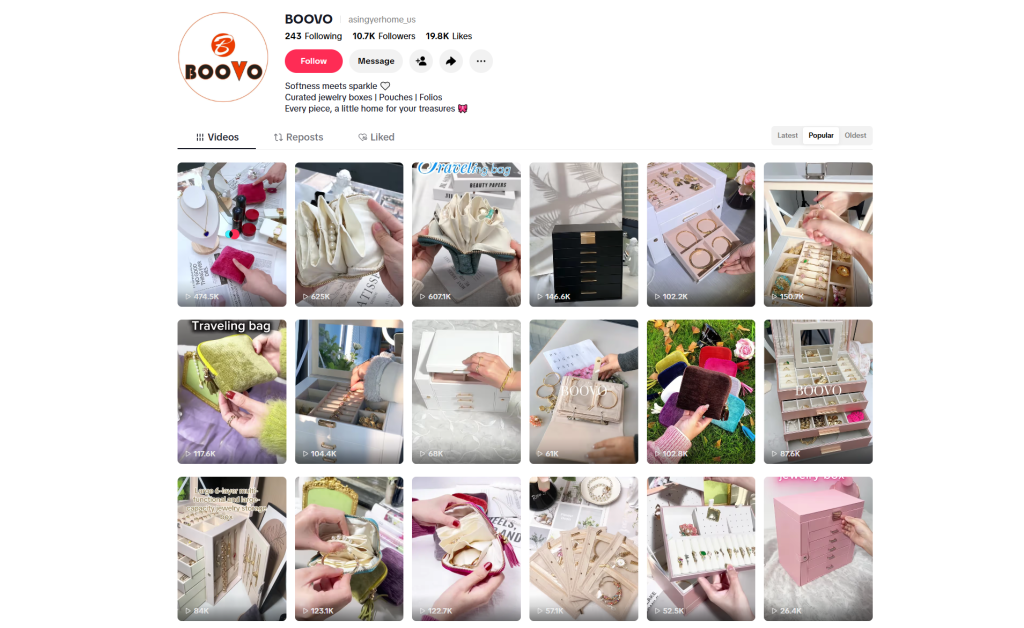
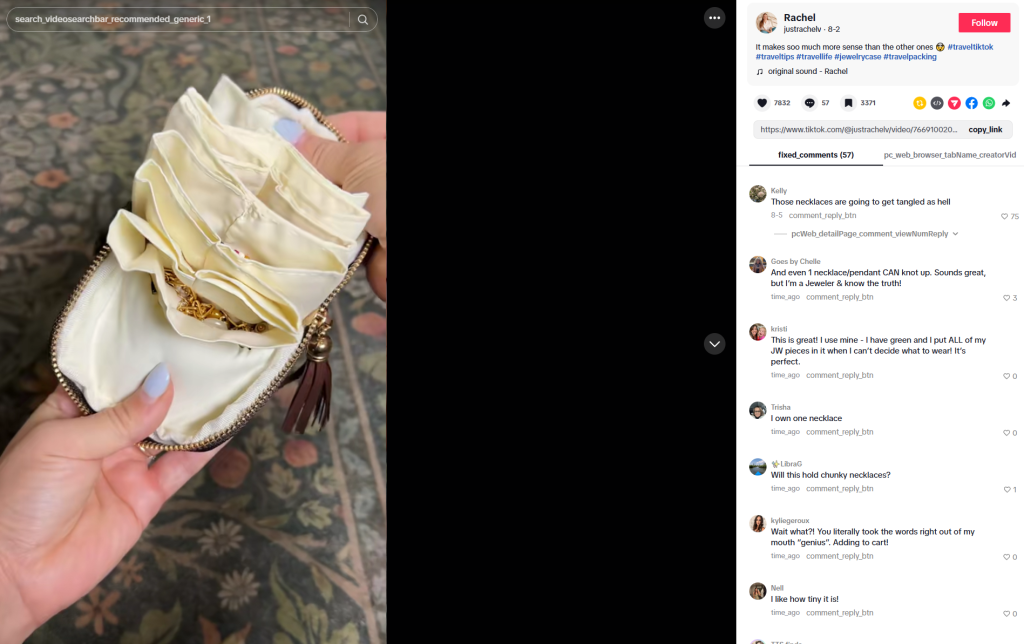
The product itself is simple: a palm-sized velvet exterior, multiple compartments, and a zipper closure. Yet it addresses a familiar problem for travelers: necklaces get tangled, earrings get lost, and different pieces are difficult to keep organized.
The value of this example is not simply that another small product has become popular. More importantly, it shows why consumers are willing to buy an ordinary product and what sellers can learn from the demand behind it.
Why Is a Simple Jewelry Organizer Selling So Well?
Rather than thinking of it simply as a storage product, it is more useful to see it as a solution to the small frustrations that come with traveling.
Jewelry can be surprisingly difficult to pack. Put a necklace in a bag and it may come out tangled. Earrings and rings can easily get mixed together, making it difficult to find a matching pair. Keeping jewelry in a toiletry bag may also expose it to scratches or other damage.
A small organizer solves these problems without adding much weight or taking up much space. Different pieces have their own compartments, while the compact size makes it easy to place inside a suitcase or handbag.
The product also requires very little explanation. Consumers can immediately understand what it does and why they might need it. That is an important advantage for small products: when the problem and solution are both obvious, the purchase decision becomes much easier.
Another advantage is that the product’s value is easy to demonstrate. The difference between tangled jewelry and neatly organized jewelry can be shown in just a few seconds. There is no need for a long product description to explain the benefit.
For sellers, products like this can therefore have a relatively straightforward content angle. Showing the problem and then showing the solution may be more effective than simply listing product specifications.
The Bigger Opportunity Is the Travel Use Case
If the takeaway from this example is simply “find more jewelry organizers,” then much of its value is being missed.
The more interesting opportunity is the travel organization need behind the product.
Travelers have to organize much more than jewelry. Makeup, skincare containers, charging cables, earbuds, medication, socks and other small items all have something in common: they take up little space individually, but can quickly become difficult to organize.
A jewelry organizer addresses just one of these problems.
That means sellers can look further into the same use case. Cosmetic organizers, toiletry bags, cable organizers, electronic accessories cases, shoe bags, travel medication organizers and luggage space-saving products may all address similar needs.
The key question is no longer “What other jewelry products can I sell?” Instead, it becomes “What other problems do travelers have when organizing their belongings?”
Limited luggage space creates a demand for space-saving products. Too many small items create a need for better organization. Frequent movement creates a demand for portability.
Once sellers look beyond the individual product, a single jewelry organizer can become a starting point for exploring a much broader consumer scenario.
What Makes a Small Product Worth Watching?
Not every inexpensive product has the same potential. When evaluating a product, sellers can start with a few simple questions.
First, does it solve a clear problem?
A useful small product should not require consumers to think for a long time before understanding why they need it. Organizing belongings, saving space, improving portability and reducing cleaning time are all relatively easy-to-understand needs. The clearer the connection between the product and the problem, the easier it is to create a reason to buy.
Second, is the value easy to demonstrate?
Products with a clear before-and-after effect can be easier to promote. A jewelry organizer is a good example because the difference between scattered jewelry and organized pieces is immediately visible.
Third, is there a clear consumer scenario behind the product?
Travel, beauty, home organization, pet care and kitchen use can all provide useful starting points for understanding consumer needs. Once the scenario is clear, sellers can better identify their target customers and explore related products.
Of course, demand alone is not enough. A product also needs a workable cost structure. Purchase price, product weight, packaging size, shipping costs, platform fees, marketing expenses and potential returns all affect the actual margin.
The difference between the purchase price and selling price should therefore not be treated as final profit.
What Should Sellers Do After Finding a Fast-Growing Product?

When a product starts showing strong sales growth, the first step should not be immediately contacting suppliers. It is better to break down the product and understand why it is selling.
Start by checking whether the sales growth is temporary or part of a longer trend. Sales data can show what is happening, but it does not explain why.
Next, look at the reason consumers are buying. Is the product solving a long-standing problem? Is a particular consumer scenario growing? Is the price attractive, or does the product simply make a common task easier?
Once the underlying demand is clear, sellers can look for related products around the same scenario instead of copying the exact product. In the jewelry organizer example, the broader direction is travel organization rather than another identical jewelry case.
Market research is another important part of this process. Sellers need to understand what consumers in different regions are looking for, what competitors are selling and how prices are changing. Incomplete market information can easily lead to poor product decisions.
This is where a stable network environment can become useful for market research. NOVproxy’s IP services can help sellers access public web pages from different regions and gather more market information, giving product research a broader data foundation rather than relying entirely on assumptions.
After the market opportunity has been assessed, sellers can move on to supplier verification. Product quality, minimum order quantities, packaging, logistics and after-sales costs all need to be considered. A product may have clear demand but still be unsuitable if its cost structure does not support the required investment.
Finally, small-scale testing can help validate the opportunity. Sellers can first observe demand, content performance and conversion before deciding whether to increase inventory and marketing investment. This is generally more manageable than committing heavily to stock before the market has been tested.
From One Product to the Next Opportunity
The jewelry organizer is interesting partly because it does not depend on complicated technology or major innovation.
Its strength is that it solves a specific problem in a simple way. Consumers can understand why they need it and quickly see the benefit.
That is a useful direction for sellers to consider.
New products appear every day, but the more valuable signal is often not the sales volume of one particular product. It is the demand behind that sales growth.
When a small product starts gaining traction, sellers can ask what problem it solves, what consumer scenario it belongs to and what other needs exist within that same scenario.
This changes the way product research works. Instead of searching endlessly for the next individual bestseller, sellers can start with a proven demand and explore the products that could serve it.
Conclusion
A jewelry organizer selling well does not mean sellers should immediately look for similar products.
The more useful lesson is how to evaluate small products. Start with the problem they solve, identify the consumer scenario behind that problem, and then look for other unmet needs within the same scenario.
For sellers, the real value is not remembering one successful product. It is learning how to turn a product’s performance into a clue about what consumers want next.
So when a seemingly ordinary product suddenly starts gaining orders, don’t rush to copy it. First understand why it is selling, explore the broader consumer scenario, and then validate the opportunity through market research, suppliers and costs.
Find the demand behind the product, and you may find the next opportunity.