




Key Takeaways
- Mobile IP and residential IP differ mainly in their network sources: mobile networks and home broadband networks.
- Mobile IP is better suited for mobile testing, while residential IP supports broader use cases such as market research and data analysis.
- The right IP type depends on specific business needs and application scenarios.
When businesses conduct market research, analyze online information, or test network environments in different regions, one common question often comes up: should they choose a mobile IP or a residential IP?
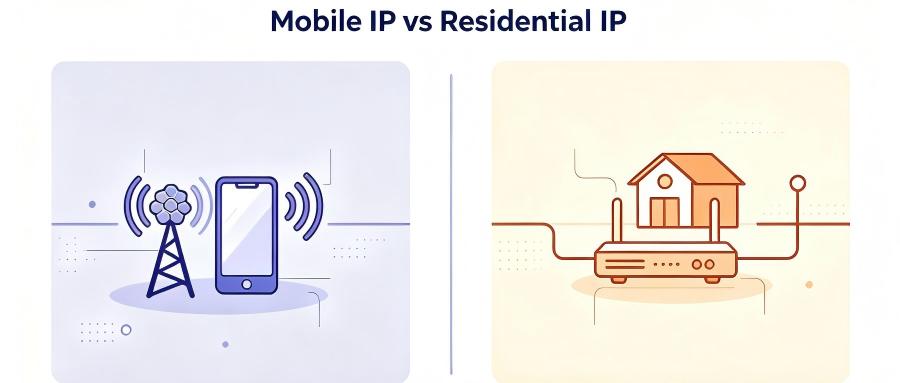
Although both are widely used IP types, they come from different network environments and work in different ways. Mobile IPs are provided through mobile carrier networks, while residential IPs usually come from home broadband connections.
The source of an IP address can affect network stability, geographic coverage, and suitability for different business scenarios. Understanding the difference between mobile IP and residential IP can help businesses choose the right IP solution based on their specific needs.
This article explains the differences between mobile IP and residential IP, including their sources, characteristics, advantages, limitations, and common use cases.
What Is a Mobile IP?
A mobile IP is an IP address assigned through a mobile carrier network. It is typically associated with devices such as smartphones and tablets that connect to the internet through cellular networks.
When a device accesses the internet through 4G or 5G networks, data is transmitted through mobile carriers, and the device is assigned a corresponding IP address. Compared with fixed broadband networks, mobile networks are more dynamic and can be affected by factors such as device location, signal strength, and network switching.
Advantages of Mobile IP
Suitable for Mobile Network Testing
Mobile IPs are based on cellular networks and provide conditions similar to mobile device connections. They are suitable for scenarios that require testing mobile access performance, such as mobile app testing and mobile webpage checks.
Provides Geographic Network Information
Mobile networks rely on carrier infrastructure, and network conditions can vary between countries and regions. Using mobile IPs from different locations allows businesses to analyze mobile network performance across different areas.
Limitations of Mobile IP
Network stability can be affected by environmental factors:Mobile networks may be influenced by signal quality, network load, and carrier coverage, which can cause changes in connection performance.
Resource availability varies by region:Mobile IP resources depend on local carrier infrastructure, so availability and coverage may differ between locations.
Higher overall costs:Because mobile IP resources rely on cellular network infrastructure, their acquisition and maintenance costs are often higher than standard network resources.
What Is a Residential IP?
A residential IP is an IP address assigned by an Internet Service Provider (ISP) to a home broadband connection.
When users connect to the internet through a home router, the ISP assigns an IP address to that residential network. Compared with data center networks, residential IPs come from home broadband environments and have characteristics closer to fixed residential connections.
The quality of residential IP resources is usually related to network source, geographic coverage, and connection stability. For businesses that need to analyze information from different regions, choosing suitable residential IP resources can help reduce differences caused by different network environments.
NovProxy provides residential IP resources from different regions and countries, allowing users to select IP locations based on their target markets for regional network analysis and testing needs.

Advantages of Residential IP
Based on Home Broadband Networks
Residential IPs rely on home broadband connections and provide network conditions closer to regular household internet access. They are suitable for scenarios that require understanding regional network environments.
More Stable Network Connections
Residential broadband usually uses fixed-line connections, which are not affected by mobile signal changes or carrier switching. This provides relatively stable network conditions for continuous data analysis and testing tasks.
Coverage Across Multiple Countries and Regions
Residential IP resources are available across different countries and regions. Businesses can select IP locations based on their target markets for regional analysis, market research, and localization testing.
Limitations of Residential IP
More difficult resource acquisition:Residential IP resources depend on home broadband networks, making management and resource acquisition more complex compared with standard network resources.
Resource availability differs by location:Broadband infrastructure varies between countries and cities, which can affect residential IP availability and coverage.
Higher cost than standard network resources:Because residential network resources require more complex management and maintenance, residential IPs usually have higher costs than data center IPs.
Mobile IP vs Residential IP: Key Differences
Mobile IP and residential IP are both common IP types, but they differ in network source, connection method, stability, and typical applications.
| Comparison | Mobile IP | Residential IP |
| Network Source | Mobile carrier networks | Home ISP networks |
| Connection Type | 4G/5G cellular networks | Home broadband networks |
| Network Characteristics | Strong mobile network features | Fixed broadband characteristics |
| Stability | More affected by signals and network conditions | More stable fixed connection |
| Geographic Attribute | Related to mobile carrier coverage | Related to residential broadband location |
| Common Uses | Mobile testing, mobile network analysis | Data analysis, market research, localization testing |
Different Network Sources and Connection Methods
The main difference between mobile IP and residential IP comes from their network sources.
Mobile IPs rely on cellular networks and carrier infrastructure, while residential IPs come from fixed home broadband connections. This difference affects their network characteristics and suitable use cases.
Different Network Stability
Mobile networks can be affected by signal strength, device movement, and network conditions. Residential IPs usually rely on fixed broadband connections, providing more consistent network performance for long-term analysis and testing scenarios.
Different Geographic Characteristics
Mobile IP locations are mainly determined by mobile carrier coverage, while residential IP locations are related to the physical location of home broadband connections. This makes residential IPs suitable for businesses that need regional market information.
Similarities Between Mobile IP and Residential IP
Although mobile IP and residential IP come from different network sources, they also share some similarities.
Both are based on real network environments rather than traditional data center networks, and both have geographic attributes. They can be used for regional network testing, business analysis, and market research.
However, they represent different connection types. Mobile IP focuses more on cellular network environments, while residential IP is better suited for fixed broadband environments.
Mobile IP Use Cases
Mobile App and Website Testing
Mobile applications, mini programs, and mobile websites can perform differently under different network conditions.
Using mobile IPs, businesses can test product performance across different mobile network environments, including page loading, functionality, and mobile compatibility.
Mobile Content Display Testing
Mobile users in different regions may see different website content, page layouts, or advertising information.
Mobile IPs allow businesses to check content display under mobile network conditions and understand regional mobile access experiences.
Mobile Network Research
Mobile network conditions can vary between regions and carriers. Mobile IPs can be used to analyze regional mobile network characteristics and support product testing and planning.
Residential IP Use Cases
Residential IPs are widely used in scenarios such as data analysis, eCommerce research, search result analysis, and website localization testing.
For example, NovProxy residential IP resources allow users to view public market information from different regional network environments, including product displays, search results, and website performance.
Public Web Data Analysis
Residential IPs are commonly used for organizing public web information and market data, including product prices, product details, customer reviews, and industry information.
By using residential IPs from different regions, businesses can analyze market changes and collect information related to target markets.
E-Commerce Market Research
Product demand, pricing, and market trends can vary between regions.With residential IPs from target locations, businesses can analyze local market information, product performance, competitor activities, and consumer preferences.
Regional SEO Monitoring
Search results can vary depending on location, language, and network environment.SEO teams can use residential IPs from different regions to monitor keyword rankings, competitor performance, and search result changes in target markets.
Website and Advertising Localization Testing
Websites, landing pages, and regional advertisements may display different content depending on visitor location.Residential IPs can help businesses check website pages, advertising materials, and content displays across different regions.
Market Trend Analysis
When entering new markets, businesses need to understand industry changes, product trends, and consumer demand.Residential IPs can support long-term collection and organization of public market information for market analysis.

Frequently Asked Questions
Which is better for data analysis: residential IP or mobile IP?
Residential IPs are usually more suitable for multi-region information analysis, such as market research, eCommerce analysis, and SEO monitoring. Mobile IPs are better suited for mobile network testing scenarios.
Which countries and regions do residential IPs cover?
Residential IP coverage depends on available resources in different locations. Users can choose residential IPs based on their target markets and testing requirements.
What is the difference between residential IP and data center IP?
Residential IPs come from home broadband networks, while data center IPs usually come from server facilities. Residential IPs are more suitable for scenarios that require regional network characteristics.
Why do businesses need residential IPs from different locations?
Website displays, search results, and public market information may vary depending on location. Using residential IPs from specific regions allows businesses to better understand local network environments.
Conclusion
There is no absolute winner between residential IP and mobile IP. The right choice depends on business requirements and application scenarios.
Residential IPs are generally more suitable for businesses that require fixed network environments, while mobile IPs are better suited for mobile network testing and mobile-related analysis.
By understanding the differences between mobile IP and residential IP, businesses can select the appropriate IP type based on their target markets, business goals, and testing needs.
NovProxy offers residential IP resources across multiple regions, allowing users to select suitable IP solutions based on their target markets and business needs.
Email: support@novproxy.com | Discount Code: VYJLpnEUQG