





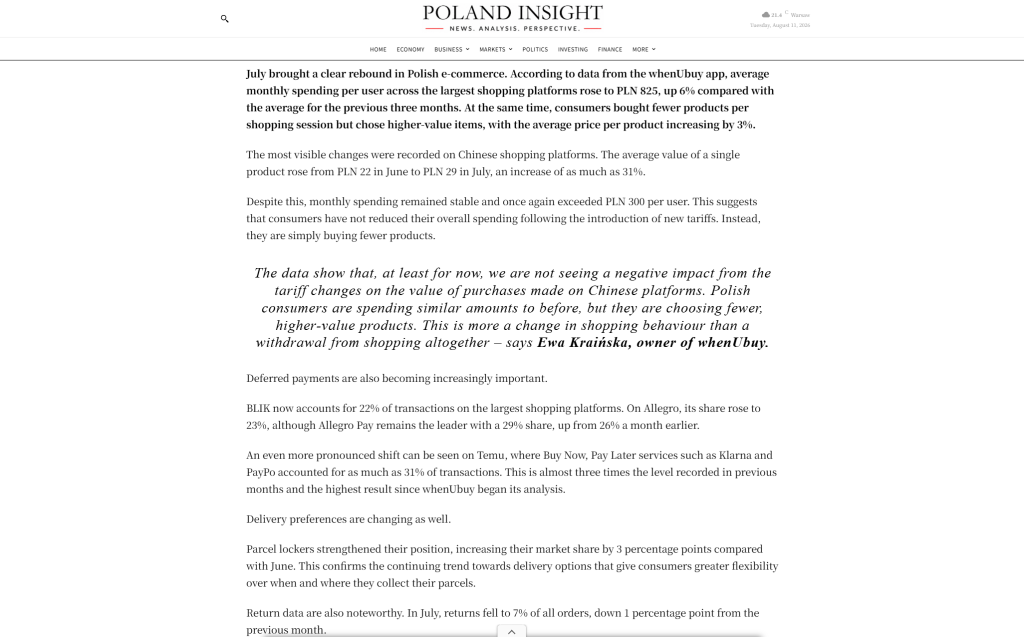
According to whenUbuy data, the average monthly online spending per consumer in Poland reached PLN 825 in July 2026, up 6% from the average of the previous three months. At the same time, consumers purchased fewer products, while the average price per item increased by 3%. On Chinese shopping platforms, the shift was even more noticeable: the average price per item rose from PLN 22 to PLN 29, an increase of about 31%, while monthly spending per user remained above PLN 300.
This suggests that Polish consumers are not simply buying less. Instead, they are becoming more selective about what they buy, how much they buy, and what they consider worth paying for. For exporters targeting Poland, this shift may be more important than the overall increase in consumer spending.
Polish Consumers Are Still Spending, but Buying Less
Polish online spending continued to grow in July. Average monthly spending reached PLN 825, 6% above the average of the previous three months, showing that demand for online shopping remains strong. However, looking only at spending levels can hide another important change: consumers are purchasing fewer products.
Higher spending, fewer products, and higher prices per item together point to a clear shift in shopping behavior. Consumers are becoming more selective about how they allocate their budgets. Instead of adding more low-priced products to their carts, they may be choosing fewer items that they consider more useful or valuable.
This trend should not simply be interpreted as a decline in consumer spending. A better explanation is that Polish shoppers are becoming more rational and selective in their purchasing decisions.
Price Still Matters, but Consumers Are Asking: Is It Worth It?
Price remains an important factor in purchasing decisions. But as consumers begin to reduce the number of products they buy, another question becomes more important: what are they willing to spend their limited budget on?
Low prices can lower the barrier to purchase and encourage impulse buying or adding extra items to an order. But consumers may now be taking a longer-term view of price. Instead of looking only at the upfront cost, they may also consider how much value a product provides over time.
For example, a PLN 20 screwdriver that lasts only a few uses may ultimately cost more per use than a PLN 60 screwdriver that can be used for much longer. If the more expensive product is used 30 times, its cost per use is only PLN 2. For consumers, the comparison is no longer simply about the price tag, but also about the value the product provides.
This does not mean exporters should simply raise their prices. Instead, they should ask whether their products give consumers a clear reason to pay more. Products with specific use cases, clear functionality, noticeable quality, or meaningful differentiation are more likely to earn a place in consumers’ budgets than products that are easily replaceable.
The Polish market is showing a renewed focus on product value. The clearer the reason a product is worth its price, the easier it may be for exporters to compete beyond price alone.
From Payments to Delivery: Consumers Are Redefining the Shopping Experience
Changes are also emerging beyond the products themselves.
Buy Now, Pay Later (BNPL) is one notable example. In July, BNPL services such as Klarna and PayPo accounted for 31% of transactions on Temu, nearly three times their level a few months earlier and the highest figure recorded by whenUbuy. This suggests that as consumers become more careful about managing their budgets, flexible payment options can also influence purchasing decisions.
BLIK is another important part of the Polish payment landscape. It accounted for 22% of e-commerce transactions, rising to 23% on Allegro, while Allegro Pay reached 29%. These figures highlight the importance of local payment preferences in the Polish market. Payment is no longer simply the final step before an order is completed; it has become part of the overall shopping experience.
Delivery preferences are changing as well. The share of parcel-locker deliveries increased by 3 percentage points in July, showing continued demand for flexible collection options. Consumers increasingly value the ability to choose when and where they receive their orders.
Returns provide another perspective on convenience. The overall return rate fell to 7% in July, while the rate remained above 21% in fashion. This suggests that the return experience deserves attention beyond the cost itself. A simple process and timely refunds can also shape how consumers view a retailer.
As a result, e-commerce competition is no longer simply about whether a product can be sold. It increasingly involves four questions:
Is the product worth buying? Is payment convenient? Is delivery flexible? Is the return process simple?

What Do These Changes Mean for the Polish Market?
Taken together, the data point to three broader trends in Poland’s e-commerce market.
First, consumer demand remains resilient, but shoppers are becoming more selective. Monthly online spending of PLN 825 and the 6% increase from the previous three-month average show that consumers are still spending online. At the same time, fewer products per purchase suggest that they are becoming more selective about where their money goes.
Second, product value is becoming more important. Consumers are still willing to spend, including on higher-priced products, but the product needs to offer a clear reason to justify the price. For highly similar products, competing mainly on price may become increasingly difficult.
Third, the shopping experience is becoming part of the competition. BNPL and BLIK reflect payment preferences, parcel lockers highlight delivery expectations, and return data point to the importance of after-sales service. These factors can influence whether consumers complete an order and whether they are willing to buy again.
The Polish market is therefore not becoming harder to sell into simply because consumers are spending less. Consumers are becoming more selective.
What Should Exporters Do Now?
These changes do not mean that exporters need to completely overhaul their market strategies. Instead, they can start by reviewing several key areas.
Reassess the Product Mix
If products are highly similar to competitors’ offerings and rely mainly on low prices to generate orders, their long-term competitiveness in Poland should be reconsidered.
Exporters can reduce their reliance on purely low-cost SKUs and put more resources into products with clear functions, specific use cases, and meaningful differentiation. For suitable products, bundles, multipacks, or upgraded versions can also increase order value.
The goal is not simply to raise prices, but to make the product’s value easier for consumers to understand.
Recalculate Actual Profit Margins
Changes in consumer behavior also make it worth reviewing existing pricing strategies.
Exporters should consider not only product costs and selling prices, but also taxes, platform fees, payment costs, logistics expenses, and potential return costs.
This is particularly important for low-value products. A product may generate a large number of orders but still provide limited profit after logistics, payment, and after-sales costs are included.
Localize Payment Options
For businesses entering the Polish market, payment options deserve close attention.
In addition to commonly used international payment methods, exporters should consider local preferences such as BLIK, BNPL, and PLN payments. If consumers have already decided to purchase but cannot find a familiar payment method at checkout, investments in advertising, traffic, and product operations may be lost at the final step.
Payment localization also requires timely access to local market information. If exporters regularly encounter slow-loading Polish e-commerce websites, market research can become less efficient. Novproxy provides Poland IP services that can help teams access local websites more consistently and track changes in prices, payment options, and competitors.
Include Delivery in the Market Strategy
The growing use of parcel lockers suggests that flexible delivery options are becoming increasingly important.
When choosing logistics solutions, exporters should look beyond cost and consider whether customers can receive orders conveniently, whether delivery times are transparent, and whether familiar local collection options are available.
In the Polish market, how a product reaches the customer is also part of the product experience.
Plan Returns and After-Sales Service in Advance
For categories such as fashion and footwear, where returns are more common, return policies should be considered from the beginning.
Product pages should minimize gaps between customer expectations and the actual product by providing accurate information about sizing, materials, colors, and use cases. Return conditions, procedures, and refund timelines should also be clearly communicated.
Reducing returns is important, but making the return process less frustrating can be just as valuable.
Look Beyond Order Volume
In a market where consumers are buying fewer but potentially higher-value products, order volume alone does not fully reflect business performance.
Exporters should also monitor metrics such as:
- Average order value
- Gross margin
- Return rate
- Refund rate
- Payment failure rate
- Repeat purchase rate
- After-sales inquiries
If order volume increases while profits decline or return and service costs continue to rise, that growth may not translate into sustainable market performance.
On the other hand, stable order volume combined with higher order value, stronger margins, and better repeat purchases could indicate a healthier product mix.

Frequently Asked Questions
Are Polish Consumers Buying Less Online?
Not exactly. Average monthly online spending reached PLN 825 in July 2026, up 6% from the average of the previous three months. The main change is that consumers are buying fewer products while paying more per item, suggesting that they are becoming more selective rather than simply stopping online purchases.
Do Polish Consumers Care More About Low Prices or Product Value?
Low prices still matter, but consumers are paying more attention to whether the price matches the product’s value. With limited budgets, shoppers may buy fewer products and spend more on items that are more durable, functional, or useful.
What Should Exporters Focus on When Entering Poland?
Beyond products and pricing, exporters should pay close attention to three areas: payment options such as BLIK and BNPL, delivery options such as parcel lockers, and after-sales service such as convenient returns. These factors can all influence purchasing decisions, so businesses should consider the entire shopping experience rather than focusing only on the product price.
Is Poland Still Worth Considering for Exporters?
Yes. Average monthly spending of PLN 825 and a 6% increase from the previous three-month average indicate that consumer demand has not significantly weakened. Instead, shopping behavior is changing. Competition is shifting from price alone toward product value, shopping experience, and service, making it important for exporters to adapt their products and operations accordingly.
Conclusion
The July data from Poland’s e-commerce market tell a more complex story than simple consumer growth. Shoppers are still spending, but they are becoming more selective about where their budgets go. At the same time, changes in payments, delivery, and returns show that consumers are looking beyond price and paying greater attention to the overall shopping experience.
Low prices can attract attention, but they do not necessarily create long-term customer loyalty. Products that offer clear value, reasonable pricing, convenient payment, reliable delivery, and smooth after-sales service are more likely to remain competitive.
Polish consumers are not simply buying less. They are becoming more selective. For exporters looking to expand into Poland, the next question is not only how to sell more, but how to make customers more willing to buy, more comfortable completing a purchase, and more likely to come back.