





Key Takeaways:
- Russia’s coffee machine market continues to grow, but sales revenue is increasing more slowly than unit sales, with mid-range and affordable products gaining market share.
- Demand for automatic milk frothing and multiple drink options is rising, making mid-range models priced below RUB 34,000 worth watching.
- Fully automatic, semi-automatic espresso, and capsule coffee machines are all showing growth, giving sellers opportunities to target different price points and consumer needs.
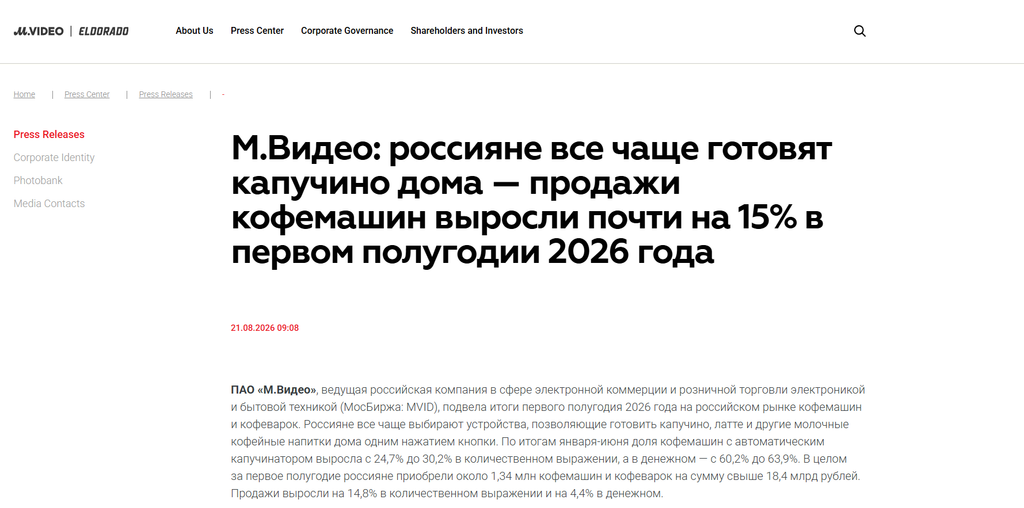
Recently, Russian retailer M.Video released its market data for coffee machines and coffee makers in the first half of 2026. Overall, the Russian coffee machine market continues to grow, with consumer demand still increasing. More importantly, however, the product structure is changing. Automatic milk frothing is becoming more popular, while mid-range products are taking a larger share of the market. Consumers are moving beyond basic functions and paying more attention to convenience, drink variety, and reasonable pricing.
For international sellers, this means the opportunity in Russia is not simply about selling more products. The bigger question is which products are better aligned with current consumer preferences.
Russia’s Coffee Machine Market Grew 14.8% in H1 2026
In the first half of 2026, around 1.34 million coffee machines and coffee makers were sold in Russia, generating more than RUB 18.4 billion in revenue. Compared with the same period last year, unit sales increased by 14.8%, while revenue grew by 4.4%.
Looking at a longer period shows that this is not a short-term increase. In 2025, around 2.6 million units were sold, up 11.9% year over year. In the first quarter of 2026, Russian consumers purchased approximately 760,000 units, with sales increasing 14% year over year, while revenue remained roughly unchanged from the previous year.
The first-quarter data already revealed an important trend. According to M.Video, average coffee machine prices were gradually declining as unit sales increased. This was mainly driven by greater availability of affordable products and stronger competition between brands. Products priced below RUB 7,000 saw particularly strong growth. Models below RUB 2,000 accounted for 25.5% of unit sales, while those priced between RUB 2,000 and RUB 7,000 accounted for 25.2%. At the same time, machines priced above RUB 18,000 still represented nearly one-quarter of sales.
Therefore, it would be too simple to describe the Russian market as a complete shift toward low-priced products. A more accurate picture is that affordable products are expanding the overall market, while higher-priced machines with more advanced functions continue to attract consumers.
Automatic Milk Frothing Is Becoming an Important Growth Driver
Automation is one of the most notable trends in Russia’s coffee machine market this year.
According to M.Video, the unit sales share of coffee machines equipped with automatic milk frothers increased from 24.7% last year to 30.2%. Their share of sales revenue also rose from 60.2% to 63.9%.
Meanwhile, machines using traditional Panarello manual frothing systems saw their unit sales share fall from 22.3% to 19%, while their revenue share declined from 25.5% to 21.8%.
This suggests that consumers are placing greater importance on convenience when preparing milk-based coffee drinks. Automatic milk frothing reduces manual steps and makes it easier to prepare drinks such as cappuccino, latte, and flat white. The feature is also becoming more common outside the premium segment.
M.Video also noted that household coffee consumption in Russia continues to develop. Consumers are no longer simply asking whether a machine can make coffee. Convenience, personalization, and drink quality are becoming increasingly important when choosing a machine.
Fully Automatic Espresso Machines Account for 66% of Revenue
By product type, fully automatic espresso machines remain the largest category by sales revenue in Russia.
In the first half of 2026, fully automatic espresso machines accounted for around 24% of unit sales but generated 66% of total sales revenue. Semi-automatic espresso machines and capsule coffee machines both increased their market shares, while traditional drip coffee machines saw their unit sales share decline.
| Product Type | Unit Sales Share | Revenue Share |
|---|---|---|
| Fully automatic espresso machines | 24% | 66% |
| Semi-automatic espresso machines | 23% | 19% |
| Capsule coffee machines | 15% | 9% |
| Drip coffee machines | 20% | 4% |
| Turkish coffee machines | Approx. 15% | Approx. 1% |
The unit sales share of semi-automatic espresso machines increased from 21% to 23%, while their revenue share rose from 17% to 19%. Capsule coffee machines increased from 14% to 15% in unit sales and from 8% to 9% in revenue.
By comparison, the unit sales share of traditional drip coffee machines declined from 23% to 20%, while their revenue share remained around 4%.
Overall, fully automatic and semi-automatic espresso machines now account for roughly half of total unit sales. Espresso-related products remain an important part of the Russian market, while semi-automatic and capsule machines continue to gain ground.
M.Video’s first-quarter best-selling product list included the De’Longhi Eletta Explore, De’Longhi Magnifica and Dedica series, Philips Series 2300, Tuvio TCM10EA, KRUPS Arabica, and Jura E8. These products provide a more concrete view of what consumers are buying. The Russian market includes fully automatic and semi-automatic machines across different price ranges, giving sellers more than one product segment to consider.
Machines Priced Below RUB 34,000 Account for More Than Half of Revenue
Price structure is another important finding in M.Video’s data.
In the first half of 2026, coffee machines priced below RUB 34,000 accounted for 52.9% of total sales revenue, up from 44.4% a year earlier. That represents an increase of 8.5 percentage points.
This trend is not limited to the first half of the year. In the first quarter of 2026, products priced below RUB 7,000 grew rapidly. In 2025, machines priced below RUB 5,000 accounted for around 40% of unit sales, while products priced above RUB 25,000 still contributed roughly one-fifth of total sales.
These figures point to a clear segmentation in the Russian coffee machine market.
Unit sales increased 14.8%, while revenue grew by only 4.4%. This indicates pressure on average selling prices, but it is not enough by itself to conclude that the market has entered a price war. Combined with the rising revenue share of machines priced below RUB 34,000, the clearer signal is that mid-range and affordable products are gaining more market share.
For international sellers, competing solely on the lowest price may not be the best approach. A more useful strategy is to study how to build competitive features into machines priced below RUB 34,000.
What Coffee Machines Are Selling on Russian E-Commerce Platforms?
M.Video’s data provides a broad view of the Russian coffee machine market. Looking at actual products on Russian e-commerce platforms shows that mid-range automatic machines can already offer a fairly complete set of features.
For example, Philips EP3246/70 is a representative mid-range fully automatic coffee machine available on Ozon. It supports both coffee beans and ground coffee, offers 12 grinding settings, and can prepare espresso, double espresso, cappuccino, latte macchiato, Americano, and other drinks.
This type of configuration fits the growing demand for automated machines with multiple drink options in the Russian market.
For sellers, competition in the mid-range segment is not only about price. Grinding settings, drink selection, milk frothing, cleaning requirements, and ease of operation can all influence consumer decisions.
Meanwhile, M.Video’s first-quarter best-selling list included different models such as De’Longhi Eletta Explore, Magnifica, and Dedica, Philips Series 2300, and Tuvio TCM10EA.
The list also shows that Russian consumers are not concentrated around a single type of machine. Fully automatic and semi-automatic products across different price ranges can all find demand, giving sellers more flexibility when evaluating product opportunities.
Consumers Care About More Than Features
Product pages on Russian e-commerce platforms show that consumers are paying attention to more than basic specifications. Ease of operation, cleaning requirements, and user instructions can also affect the overall experience.
Philips EP3246/70 is a useful example. Although this type of mid-range fully automatic machine already offers multiple drinks and automated functions, the actual user experience can still influence purchasing decisions and product reviews.
For sellers entering the Russian market, it is useful to look beyond the specifications of best-selling products and examine consumer feedback on similar machines. This can help identify practical concerns related to operation, cleaning, noise, and milk frothing performance.
Coffee machines are long-term household appliances, so hardware specifications are only part of the purchasing decision. The completeness of user manuals, ease of understanding the controls, cleaning requirements of the milk frothing system, and availability of consumables and replacement parts can all affect the customer’s experience.
Simply copying the appearance and features of a popular product may therefore not be enough. Localized manuals, product guides, and after-sales accessories can also become part of a product’s competitive advantage.
For sellers who plan to continue researching the Russian market, it is worth monitoring product pricing, sales trends, and competitors on local e-commerce platforms. NovProxy’s IP resources across different regions can also support public web research, helping sellers with market analysis and product selection.

Brand Competition Remains Strong
The Russian coffee machine market includes multiple competing brands, with significant differences between unit sales and revenue performance.
By revenue, De’Longhi led the market with a 31.6% share, well ahead of other brands. Polaris, Philips, KRUPS, and Tuvio accounted for 6.8%, 6.5%, 4.2%, and 3.6%, respectively.
By unit sales, De’Longhi also ranked first with a 12.2% share. Kitfort followed with 9.9%, while Tuvio, Polaris, and Redmond accounted for 4.8%, 4.4%, and 3.5%, respectively.
The difference between the two rankings is particularly interesting. De’Longhi has a much higher revenue share than unit sales share, suggesting that its products are positioned at relatively higher price points. Kitfort, on the other hand, has a high unit sales share but does not rank among the top five by revenue, indicating a stronger focus on affordable products and sales volume.
Tuvio ranks among the top brands in both dimensions, with a 4.8% unit sales share and a 3.6% revenue share. M.Video also identified Philips and Tuvio as two brands showing particularly strong growth in the first half of 2026.
Overall, opportunities in Russia are not limited to premium brands. Different brands are targeting different consumer groups through pricing and product positioning, leaving room for mid-range and affordable machines.
Three Coffee Machine Segments Worth Watching in Russia
Based on M.Video’s market data and actual products available on Russian e-commerce platforms, three product directions stand out.
| Product Direction | Key Price Range | Core Features | Market Performance | Priority |
|---|---|---|---|---|
| Automatic milk-frothing machines | Below RUB 34,000 | Automatic milk frothing, multiple drinks, adjustable grinding | Unit sales share of automatic milk-frothing machines rose to 30.2% | High |
| Semi-automatic espresso machines | Mid-range | Manual operation, espresso extraction | Unit sales share increased from 21% to 23% | Medium-High |
| Capsule coffee machines | Affordable segment | Simple operation, compact size | Unit sales share increased from 14% to 15% | Medium |
Automatic milk-frothing machines deserve the highest priority. Machines priced below RUB 34,000 already account for 52.9% of revenue, while the unit sales share of automatic milk-frothing machines has increased from 24.7% to 30.2%. Both the price segment and product feature have clear market support.
Semi-automatic espresso machines can be considered the second direction. Their unit sales and revenue shares have both increased, suggesting that demand for espresso-style coffee is not limited to fully automatic machines.
Capsule coffee machines are more focused on convenience. Although they account for only 9% of revenue, both unit sales and revenue have increased, making them worth monitoring for entry-level demand.
Overall, sellers can prioritize mid-range machines priced below RUB 34,000 with automatic milk frothing and multiple drink options, while using semi-automatic espresso and capsule machines as complementary directions. The exact price point should still be evaluated alongside local competitor pricing, sales performance, and consumer reviews.

Conclusion: Russia’s Coffee Machine Market Is Moving from Demand to Choice
Russia’s coffee machine and coffee maker market continued to grow in the first half of 2026, but the most important takeaway is not simply the 14.8% increase in unit sales. The bigger story is the change in product structure behind that growth.
Affordable products are expanding their market presence, automated features are moving further into the mid-range segment, and espresso-related machines continue to see strong demand. Consumers are increasingly looking for more functions at reasonable prices, making mid-range functional products an important area of competition.
For international sellers, focusing only on the overall 14.8% market growth is not enough. The more important question is where that growth is actually coming from.
Based on the current data, mid-range coffee machines priced below RUB 34,000 with automatic milk frothing, along with growing semi-automatic espresso and capsule machines, are worth prioritizing for further product research and market analysis.