





Key Takeaways
- Shein’s IPO valuation shows that low-price e-commerce is facing a more complex market environment.
- Sellers should focus on real product profits and reduce their reliance on a single market or short-lived bestsellers.
- By continuously monitoring market demand, competitors, and business data, sellers can spot opportunities earlier and reduce investment in high-risk products.
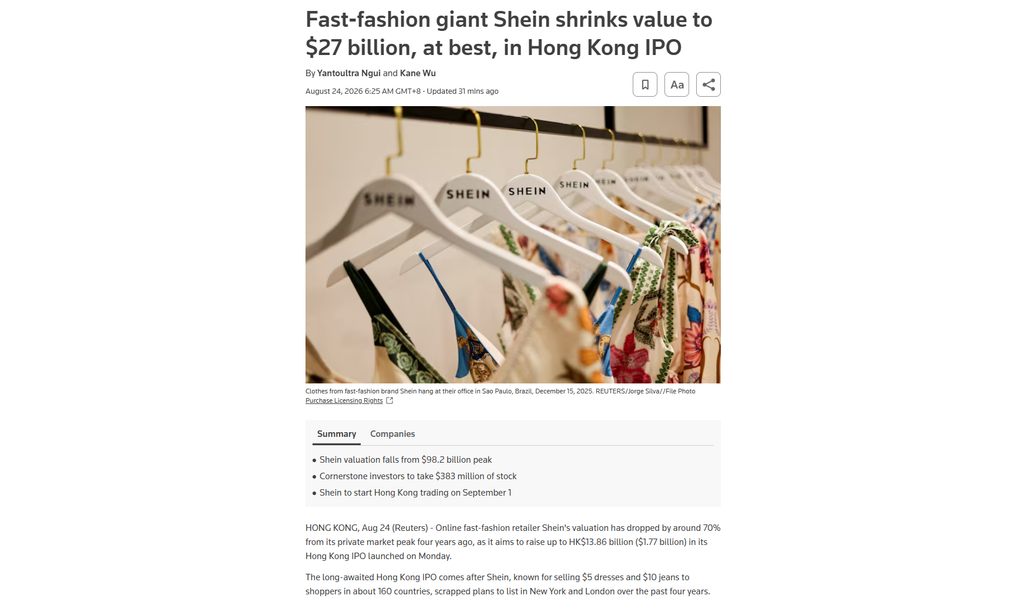
On August 23, Shein officially launched its Hong Kong IPO, planning to issue around 280 million shares at an offering price of HK$47.60 to HK$49.50. At the top end of the price range, the IPO could raise about $1.77 billion, giving the company a valuation of roughly $27 billion. Shein is expected to list on the Hong Kong Stock Exchange on September 1.
However, this valuation is significantly below the nearly $100 billion peak valuation Shein reached in 2022. While the change reflects factors including the company’s own growth and profitability, the low-price e-commerce market is also facing a more challenging environment.
For sellers, the real takeaway is not Shein’s stock performance after the IPO, but what these changes mean for their own businesses.
Price competition is becoming tougher, while overseas policies, logistics costs, and operating expenses continue to change. The old approach of following bestsellers and cutting prices to drive volume is becoming harder to sustain over the long term. Sellers need to take another look at their products, markets, and overall business strategies.
Don’t Just Focus on Low Prices: First Calculate Your Real Product Profit
In a highly competitive market, cutting prices is often the most straightforward response. But for small and medium-sized sellers, constantly lowering prices can create a cycle where sales increase while profits fall. To maintain sales, they may then need to spend more on advertising, further reducing their returns.
Large e-commerce companies can use their scale, supply chains, and data capabilities to reduce costs. Smaller sellers cannot easily replicate these advantages. Simply matching competitors on price may bring in more orders, but it can also steadily reduce profit margins.
Instead of constantly asking, “Can I lower the price again?” sellers should first calculate how much they are actually making from each product.
In addition to sourcing costs, the calculation should include international shipping, platform fees, advertising expenses, warehousing, return losses, tariffs and import costs, and currency fluctuations. Only by including the full cost structure can sellers determine whether a product is genuinely profitable or simply generating attractive sales figures.
Sellers should also conduct a risk review of their existing SKUs. Products with heavy competition, high price transparency, growing numbers of competitors, and limited margins are generally less able to absorb cost increases.
This is particularly important for products that rely on constant price cuts to generate orders. If logistics or import costs rise slightly and the product immediately becomes unprofitable, its current sales performance may not justify further investment.
Don’t Put All Your Growth Into One Market
Product profitability is only one part of the equation. Sellers should also take a closer look at their market structure.
Shein previously benefited from shipping small packages directly to overseas consumers, which helped create a cost advantage. But as import policies, tariffs, and related regulations change in markets such as the US, the underlying cost structure can also change.
The same applies to smaller sellers. Strong sales in one market today do not necessarily mean that market will remain the best place to invest tomorrow. Changes in local policies, logistics costs, or consumer conditions can quickly affect profitability.
Sellers can start by reviewing data from the past three to six months and comparing sales, profit contribution, logistics costs, and return rates across different markets.
One situation deserves particular attention: a market may generate a large share of orders without contributing a similar share of profits. If sales are highly concentrated in one market but actual returns remain low, putting more money into that market may not be the best choice.
That does not mean sellers should immediately expand into ten or more countries. A more practical approach is to select two or three promising markets, study local demand and competition, and then test products on a small scale.
Only after real orders, profits, and operating costs have been validated should sellers gradually increase their investment.
Test first, then scale, rather than expanding blindly.

Don’t Choose Products Based Only on Current Sales: Look at How Long the Demand Can Last
Profitability and market selection answer the questions of “what to sell” and “where to sell.” Product selection determines whether that product can continue to perform over time.
One reason Shein can launch large numbers of products quickly is its ability to continuously identify changes in consumer demand and adjust its product offerings. Smaller sellers cannot replicate that scale, but they can learn from this approach to product selection.
Many sellers start by asking, “What is selling well right now?” But once a product becomes a clear bestseller, more sellers have usually already noticed the opportunity. As more competitors enter, price competition intensifies, advertising costs can rise, and the original profit margin becomes harder to maintain.
By the time a product has become an obvious bestseller, it may no longer be the best time to enter the market.
When evaluating a product, sellers can ask three questions.
Why did this demand appear?
Is it driven by seasonal changes, consumer trends, a new use case, or a long-standing problem that the product solves? Understanding why demand exists can help sellers determine whether they are looking at a short-term trend or a market opportunity with longer-term potential.
How long can this demand last?
Some products become popular because of a short-term event, only to see sales decline quickly once the attention fades. Products with stable use cases and recurring demand are generally more suitable for long-term business.
Is there still room for profit?
Even if demand is growing, a market may not be worth entering if competitors have already flooded in, prices are falling, and advertising costs continue to rise.
Instead of simply chasing established bestsellers, sellers can focus on identifying genuine demand. Search trends, competitor numbers, product reviews, customer pain points, price changes, and regional differences in demand can all help determine whether a product is worth entering.
The real value of product research is not simply finding something that sells well today, but identifying growing demand while there is still room for profit.
Turn Market Research From a One-Time Check Into Continuous Monitoring

Product and market research should not be a one-time exercise.
A product may be selling well today but enter a price war a few months later as more competitors enter the market. A market may have strong demand now but change as consumer trends, regulations, or operating costs shift.
One-time research can tell sellers what the market looks like now. Continuous monitoring helps them understand what is changing.
In day-to-day operations, sellers can focus on three types of data.
Market data includes search trends, bestselling categories, consumer trends, and changes in demand across different regions. These indicators can help sellers determine whether a market is growing or cooling down.
Competitor data includes competitor prices, the number of new products, product changes, and customer reviews. Negative reviews are particularly useful because they can reveal what customers care about and where existing products still fall short.
Business data includes sales, profits, advertising spending, return rates, and inventory turnover. Combining external market information with internal business data gives sellers a clearer picture of whether a product is still worth investing in.
For sellers who need to monitor public websites and competitor information across different regions over time, regional residential IP resources can also make market research more convenient. For example, NovProxy provides residential IP resources across multiple locations that can be used for overseas market research and competitor monitoring.
The goal is not to collect huge amounts of data every day. What matters is establishing a consistent monitoring routine. Even recording a few key indicators every week can be more useful than searching for data only after a problem appears.
4 Practical Adjustments Sellers Can Make Now
Understanding these changes does not mean sellers need to overhaul their entire business. Instead, they can start by reviewing four areas.
1. Recalculate the Profitability of Existing Products
Start by dividing existing SKUs into high-profit, normal-profit, and low-profit products.
For products that have low margins, intense competition, and high sensitivity to logistics, tariffs, or advertising costs, sellers should reconsider whether additional inventory and advertising investment is justified.
Sales volume should not be the only metric. A product may sell thousands of units in a month, but if very little profit remains after all expenses, or if it requires continuous spending on advertising and inventory, that growth may not be sustainable.
2. Evaluate Market Concentration Risk
Use data from the past three to six months to compare sales, profits, logistics costs, and return rates across different markets.
If one market accounts for most of the business, it is worth identifying potential alternatives early. There is no need to move every product into new countries immediately. Sellers can start by testing a small number of products and evaluating real demand and profitability.
Once a new market demonstrates stable demand and reasonable margins, investment can gradually increase.
3. Build a Simple Competitor Monitoring Sheet
Market monitoring does not require complicated tools or analytical models.
Sellers can create a simple spreadsheet and record several indicators every week:
| Metric | What to Track |
|---|---|
| Competitor prices | Are prices consistently falling? |
| Number of competitors | Are large numbers of new sellers entering? |
| New products | Are new product directions emerging? |
| Customer reviews | What new needs or pain points are appearing? |
| Category trends | Is demand continuing to grow? |
After tracking these indicators for a period of time, many changes become easier to identify than they would be from looking at a single day of data.
For example, if a competitor keeps cutting prices for several consecutive weeks, it may indicate increasing competition. If negative reviews for a product begin to focus on the same issue, that could reveal a new customer need and even point to an opportunity for product improvement.
4. Set Clear Product Exit Conditions
Many sellers know when to increase investment but do not have clear rules for when to stop.
Sellers can establish several warning signals in advance, such as declining gross margins, rising advertising costs, a large influx of competitors, significantly higher return rates, and sustained declines in market demand.
A short-term change in one metric does not necessarily mean a product should be discontinued. The bigger warning sign is when several indicators continue to deteriorate at the same time.
If this continues, sellers can gradually reduce inventory and advertising investment and reassess whether the product is still worth keeping, rather than continuing to put money into a declining opportunity.
Calculate first, then decide. Test first, then scale. When multiple risk signals persist, cut losses in time.
What Can Sellers Really Learn From Shein?

Shein’s IPO does not mean that the low-price e-commerce model has failed. However, it does suggest that relying solely on low prices and rapid expansion is becoming more difficult.
What smaller sellers can learn from Shein is not simply its low-price strategy. Shein can quickly gather market information, identify consumer demand, adjust products, and respond to market changes through its supply chain and inventory management.
Smaller sellers may not be able to replicate Shein’s scale or supply chain, but they can adopt the same underlying mindset:
Get information faster, identify demand faster, adjust products faster, and keep inventory and costs under control.
The future of competition will not simply be about who can offer the lowest price. It will also be about who can identify market changes earlier and respond faster.
Conclusion
Shein’s Hong Kong IPO is an important industry event, but for ordinary sellers, its final valuation is not the most important takeaway. What matters more is what the event reveals about the changing environment in which they operate.
Instead of constantly chasing every bestseller and getting pulled into price wars, sellers should take another look at product profitability, market structure, product selection, and their ability to gather market information.
The ability to continuously detect market changes and adjust products, markets, and investment at the right time will matter far more than simply offering a lower price.