





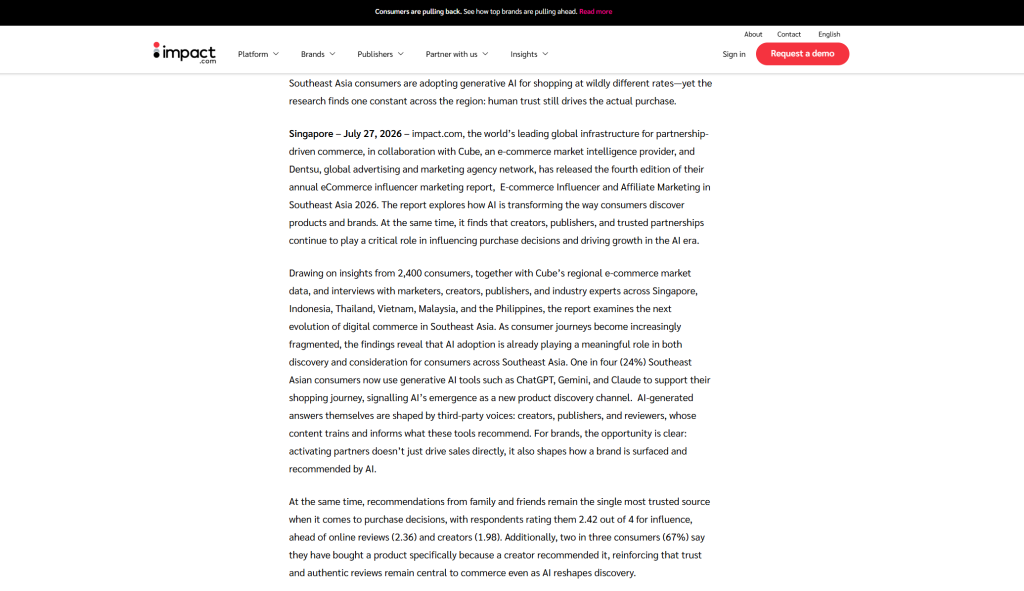
Thai consumers are changing the way they discover and purchase products. A joint study by Cube and impact.com found that Thailand scored 2.24 out of 4 for influencer-driven purchasing power, above the Southeast Asian average of 1.98. Its score for generative AI adoption in commerce also reached 2.02, higher than the regional average of 1.82.
More notably, 9% of Thai consumers said they had purchased a product because they trusted a creator, compared with 6% across Southeast Asia. These figures suggest that consumers are no longer focused only on price and product specifications. Trust from creators and product information provided by AI are also becoming part of the purchase decision.
For cross-border sellers targeting Southeast Asia, this means there are more ways for products to get discovered. Alongside traditional search and e-commerce platforms, creator content and AI-powered shopping are becoming trends worth watching.
Why Are Thai Consumers Trusting Creators More?
Creators Are Influencing Actual Purchases
In the past, brands mainly used creator marketing to increase exposure and awareness. With the growth of short-form video and social commerce, however, creators are increasingly influencing consumers’ purchasing decisions.
In Thailand, 9% of consumers said they had purchased a product because they trusted a creator. While this does not mean most consumers rely entirely on creators, it does point to a clear shift: when consumers discover a product, they may look beyond price and specifications and consider whether someone they trust has actually recommended it.
This can be especially important for products that require hands-on experience or are difficult to evaluate from images alone.
Trust Is Becoming a New Purchase Factor
When consumers face a wide range of products, they often need more than basic product information. They also need a reason to choose one product over another.
A brand’s website can explain what a product does, while a creator’s personal experience, use cases, and opinions can help consumers decide whether it is right for them. As a result, the role of creators is gradually expanding from simply generating traffic to helping consumers make purchasing decisions.
Creator Commerce Is Entering Southeast Asian E-Commerce
This shift is also driving the growth of Creator Commerce. Creators introduce products through their content and direct consumers to product pages, making the path from product discovery to purchase more direct.
For cross-border sellers, this does not mean they need to work with creators who have millions of followers. Creators with relevant audiences, strong product alignment, and genuine engagement can also attract valuable customers.
Instead of focusing only on follower counts, sellers should pay attention to engagement, clicks, and actual conversions.
AI Is Becoming a New Shopping Entry Point

Consumers Are Starting to Use AI to Discover Products
At the same time, AI is changing how consumers find and evaluate product information.
In the past, shoppers typically searched for keywords, browsed multiple product pages, and compared their options themselves. Now, they can describe what they need to an AI tool and use it to filter products, organize information, or provide purchase recommendations.
This means AI is gradually moving from a general information tool into the shopping journey.
AI Will Not Replace Search or Creators
This does not mean traditional search or creators will immediately be replaced by AI.
Search engines and e-commerce platforms remain important product discovery channels, while creators continue to influence trust and purchasing decisions.
AI is better viewed as an additional product discovery channel.
In the future, consumers may find products through search, discover them through creator content, or ask AI directly for recommendations. These channels are not necessarily replacing one another. Instead, they can work together to shape the consumer journey.
Southeast Asia Is Entering a New Stage of AI Commerce
This trend could become even more significant. The study estimates that by the end of 2027, around 20% of Southeast Asian consumers will have completed at least one AI-driven shopping journey.
For cross-border sellers, this means AI shopping may still be developing, but it is already worth preparing for.
As more consumers use AI to find products, having clear and complete product information could also affect how easily a brand and its products can be discovered and understood.
What Can Cross-Border Sellers Do Now?
AI shopping is still developing, so sellers do not need to completely change their marketing strategies overnight. A more practical approach is to start with a few basic areas.
Make Product Information Clearer
Product pages should not only list prices, sizes, and specifications. They should also quickly answer:
- What is the product?
- Who is it for?
- What problem does it solve?
- What are its main features?
- How is it different from similar products?
Clearer information makes it easier for consumers to decide whether a product is right for them and helps search engines and AI understand the product.
Sellers can start with their core products and check whether their product pages fully answer the questions customers are most likely to ask before buying.
Try Working With the Right Creators
If the target market has a mature creator ecosystem, cross-border sellers can start testing creator marketing.
There is no need to immediately work with major influencers. Creators who are relevant to the product, match the target audience, and have genuine engagement can be a good starting point.
During the process, sellers should also look beyond video views and follower counts. Clicks, visits, add-to-cart activity, and actual orders are better indicators of whether a creator is a good fit.
Sellers can start with a small number of creators, measure actual clicks and conversions, and then decide whether to expand the partnership.
For sellers targeting different overseas markets, it can also be useful to understand local consumer behavior and access conditions before testing creators and marketing channels. Novproxy provides IP services across different regions, helping businesses conduct overseas market research, monitor competitors, and test website access to support their market strategies.
Prepare Content for the AI Shopping Era
There is no need to build a complicated AI marketing system just for AI shopping.
A more practical approach is to improve the basics first. Clearly explain product features, use cases, and target customers, answer common questions, and build credibility through authentic product content and customer reviews.
This content can support traditional search while helping consumers understand products more easily, creating a stronger foundation for AI-driven product recommendations in the future.
Instead of chasing a specific AI tool, sellers should first make sure their product information, FAQs, and use cases are complete and easy to understand.
What Does the Thai Market Mean for Cross-Border Sellers?

Thailand is worth watching not only because of its growing e-commerce market, but also because consumers there show relatively high levels of both creator influence and acceptance of AI in commerce.
This suggests that consumer shopping journeys could become increasingly diverse. Shoppers may discover products through search, learn about them through creator content, or receive recommendations from AI tools. Information discovery, product comparison, and trust-building may increasingly happen across different channels rather than through a single entry point.
Thailand is particularly interesting because it is moving along two tracks at the same time: trust and AI efficiency. Consumers are willing to rely on creator recommendations to reduce purchase uncertainty, while also turning to AI tools to find and process information more efficiently. This suggests that e-commerce competition in Southeast Asia is gradually expanding beyond price comparisons and search rankings to include information discovery, content influence, and consumer trust.
For cross-border sellers, there is no need to wait until these new shopping behaviors are fully mature. Alongside maintaining search visibility and strong product pages, sellers can start testing creator partnerships and developing clearer, more complete product content.
Conclusion: Product Discovery Is Becoming More Diverse
The changes in Thailand show that Southeast Asian e-commerce is moving toward a more diverse product discovery environment. Creators are influencing consumer trust and purchase decisions, while AI is emerging as a new source of product information and discovery.
This does not mean search is losing its value. Instead, cross-border sellers need to pay attention to a wider range of traffic and discovery channels.
For brands looking to expand into Southeast Asia, three steps are worth starting with: make product information clearer, test partnerships with relevant creators, and prepare content for the emerging AI shopping environment.
The future of e-commerce competition will not be only about who ranks highest in search results, but also about who can be discovered, understood, and trusted across more product discovery channels.