


In today’s data-driven business environment, companies deal with large amounts of information every day. This data may come from websites, applications, APIs, or internal databases. It contains product information, user behavior, market changes, and business activity, making it highly valuable for many business operations.
But can this collected data be used directly? Usually, the answer is no. Raw data is often far less organized than it appears. A webpage may contain text, images, links, code tags, and various page elements at the same time. API responses may contain deeply nested structures, while data produced by different business systems often comes in different formats.
This information may be accurate and useful, but computer programs cannot always read and process it according to business requirements. To turn scattered and complex information into data that can support analysis and business decisions, an important step is needed: data parsing.
What Is Data Parsing?

So, what is data parsing? Data parsing is the process of identifying, reading, and converting raw data into a structured and usable format. In simple terms, it solves one core problem: helping programs understand data that may be easy for people to recognize but difficult for software to use directly.
When people browse a product page, they can quickly identify the product name, price, and customer reviews. For a program, however, a webpage is a collection of mixed information. It cannot automatically determine what each piece of content represents in a business context.
Data parsing helps programs identify the structure and relationships within the data. It follows predefined rules to break down the content, extract useful information, and organize it into a clearer format.
For example, a complete e-commerce product page may contain the product title, price, brand, specifications, reviews, and many unrelated sections. If the entire page is stored as it is, it can be difficult to filter and analyze later. After parsing, the system can extract key fields separately for price monitoring, market research, and internal business management.
Therefore, data parsing is not simply about copying data. Its core purpose is to identify information and convert its format, turning messy raw content into data that is easier to use.
Data Parsing vs. Data Extraction: What Is the Difference?
Data parsing often appears together with data extraction, but the two processes solve different problems. Data extraction focuses on obtaining target information from a data source, while data parsing focuses on identifying, reading, and organizing the data after it has been obtained.
For example, a company may obtain the complete source code of a webpage. This is the data extraction stage. The webpage may contain navigation menus, advertisements, style code, and other content besides product information. To separate the product name, price, and inventory from the rest, the webpage structure needs to be parsed to identify the relevant information.
Simply put, data extraction gets the data, data parsing organizes it, and data analysis finds patterns and business insights from the organized data. Together, these processes form an important part of the data processing workflow.
How Does Data Parsing Work?
Different data sources have different structures, so the parsing methods may also vary. However, the overall process can generally be divided into several stages.
Start With Raw Data
The parsing process starts with raw, unprocessed data. It may come from webpages, APIs, databases, business files, or internal systems. Raw data usually cannot be used directly as the final result.
For example, a product webpage may contain the product name and price along with navigation menus, recommendations, and advertisements. The system initially receives the complete page rather than an organized product dataset. Parsing starts by processing this raw content.
Understand the Data Format
Different data sources use different structures and formats. Webpages are built with HTML, APIs commonly return JSON or XML, and business files may use CSV formats. A parsing program needs to identify the data format and use the appropriate method to read its fields.
If the data format or structure is incorrectly identified, the subsequent field recognition and parsing results may also be affected. This is why different types of data require different parsing methods.
Find the Required Information Based on Rules
Data parsing is not the same as keyword searching. Its core task is to understand the internal structure of the data and the relationships between different parts.
For example, on a product page, the title, price, and reviews may appear in different parts of the page. A parsing system needs to identify these different business fields according to the page structure and associate the content with the correct meaning. It is not simply a matter of searching for specific words.
Convert Data Into a More Usable Format
After identifying the required information, the data needs to be standardized. Data from different sources can vary significantly. Prices may use different formats, dates may be written differently, and field names may not follow the same standards.
Through parsing and conversion, data from multiple sources can be organized into a consistent structure, making it easier to store, analyze, and use in other business processes.
Data Parsing vs. Data Analysis: What Is the Difference?
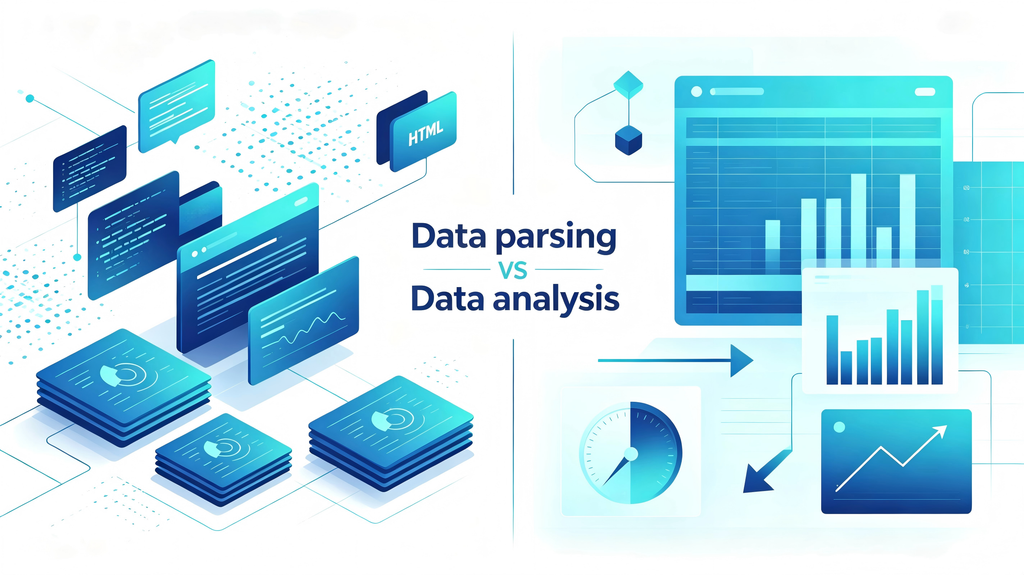
Although data parsing and data analysis often appear in the same data workflow, they have different purposes. Data parsing makes data readable and usable, while data analysis extracts business value from the data.
Unprocessed data is often just a collection of scattered information. Data parsing identifies its structure and organizes data from different sources into a consistent format. Data analysis then works with this organized data to identify trends and patterns through statistics, comparisons, and other methods.
For example, when researching popular products, a company may need to collect product names, prices, and sales information from multiple sources. Since these sources may use different formats, the data first needs to be parsed and standardized. Once the data is aligned, the company can analyze which products are growing faster and which price ranges are more popular.
| Comparison | Data Parsing | Data Analysis |
| Main goal | Make raw data readable and usable | Find patterns and trends in data |
| Data handled | Raw and semi-structured data | Organized data |
| Core tasks | Identification, conversion, organization | Comparison, statistics, prediction |
| Final result | Structured data | Analytical insights |
If the data workflow is compared to a factory production line, data parsing is like processing the raw materials at an early stage, while data analysis is the stage where value is extracted from the processed materials.
What Is a Data Parser?
A data parser is a tool or software component designed to perform data parsing tasks. It reads content according to predefined rules, identifies its structure, and converts raw information into a format that a system can understand.
Different types of data require different parsing logic. Webpages need HTML parsing to identify elements such as text, links, and images. JSON and XML API responses require corresponding parsers to read their fields, while CSV and Excel files also require specific parsing methods.
In practice, companies need to choose a solution based on the complexity of their data sources and business requirements. Simple tasks can often be handled with existing tools, while complex structures or specialized business rules may require a customized parsing solution.
What Problems Can Data Parsing Solve?
Many companies do not lack data. The real challenge is how to make that data useful. Websites, applications, business platforms, and internal systems continuously generate information, often in different formats. Without proper organization, even stored data can be difficult to use in later business processes.
Make Scattered Data Easier to Use
Raw data is often messy and inconsistent. When companies conduct market research or collect product information from different sources, they may encounter different field names, price formats, and language expressions.
After parsing and standardization, data from different sources becomes easier to compare and manage.
Reduce Repetitive Data Processing
When the amount of data is small, manual organization may still be manageable. As data continues to grow, however, manual processing becomes inefficient and more prone to errors.
Data parsing can automate repetitive filtering and organization tasks, allowing teams to focus more on data analysis and business decisions.
Support Automated Data Workflows
Many companies have established automated data workflows to regularly collect market information, monitor product changes, and synchronize internal databases.
In these workflows, data parsing converts raw data into a format that downstream systems can recognize and use. Without this step, it can be difficult to maintain a stable automated process.
Help Different Systems Exchange Information
Companies often use several business systems, such as customer management, order management, and data analysis platforms. Their data standards may differ from one another.
Parsing and format conversion can reduce compatibility issues between different systems and help information move between them more smoothly.
Challenges of Data Parsing

Data parsing can help process large amounts of information, but it also comes with several challenges.
Data Formats Can Change
Data sources are not always stable. Website redesigns, API updates, and file format changes can cause existing parsing rules to stop working correctly.
A stable parsing solution, therefore, requires ongoing maintenance to adapt to changes in the data source.
Raw Data Quality Affects the Results
Data parsing focuses on identifying and converting data, but it cannot automatically fix every data quality problem.
If the raw data contains missing, duplicate, or incorrect information, the parsed results may also be affected. In practice, data parsing is often combined with data cleaning to improve overall data quality.
Large-Scale Data Processing Creates Performance Pressure
As data volumes increase, parsing tasks place greater demands on processing speed, server resources, and concurrency.
For large, long-running data projects, companies also need to consider system stability, processing efficiency, and future scalability.
Complex Data Structures Increase Processing Difficulty
Not all data structures are simple. Some webpages contain multiple layers of nested elements, while business files may contain complex relationships between different fields.
In these cases, simple parsing rules may not cover every situation, and more flexible parsing logic may need to be designed according to the specific requirements.
Common Applications of Data Parsing
Data parsing is used across many industries. It is not only a common development technique but also a basic component behind many data-related business processes.
Web Data Processing
Webpages are an important source of external information for many businesses, but they are not structured like standard databases. They usually contain text, images, links, and various page elements.
Data parsing can break down webpage structures and extract the required information. When conducting market research, companies may use web data parsing to collect product prices, industry trends, and customer feedback from different regions.
E-commerce Market Research
Data plays an important role in e-commerce. Companies need to monitor price changes, consumer preferences, and competitor activity. However, different platforms may use different page structures and product information formats.
Data parsing can organize product information from different sources into a consistent structure, providing a clearer data foundation for market research and business planning.
For overseas market research, a stable data collection environment can also be important. NovProxy provides residential IP resources across multiple regions to support data collection requirements in different locations.
API Data Processing
APIs are an important way for different software systems to exchange data. When an application obtains user information, order status, or product details from another system, the API returns the data in an agreed format.
The program needs to read and parse this response before it can accurately access individual fields and use the required information for display, database storage, or further processing.
For systems that connect to multiple data sources, data parsing can provide a consistent way to read different API responses and reduce problems caused by different data formats.
Log Data Processing
Servers and applications continuously generate logs that record system activity, user requests, and errors.
By parsing log data, companies can extract information such as access times, error types, and request statuses. This helps technical teams identify problems and understand system performance.
AI and Machine Learning Data Processing
AI applications require high-quality data. When building knowledge bases, training models, or developing intelligent applications, raw materials often need to be organized and converted.
Data parsing can process raw text, documents, and other materials to prepare more standardized data inputs for AI models.
Data Parsing Tools: Build Your Own or Use Existing Tools?
When building data parsing capabilities, companies generally have two choices: develop their own parsing system or use an existing data parsing tool.
Neither option is always better. The right choice depends on the data sources, business complexity, and long-term requirements. If the data structure is stable and the requirements are simple, an existing tool may be enough. If the data is complex and requires specialized business rules, a custom solution provides greater flexibility.
| Comparison | Build a Data Parsing System | Use a Data Parsing Tool |
| Development cost | Requires development resources and higher initial costs | No need to build everything from scratch |
| Flexibility | Can be customized for specific business needs | Limited by the tool’s capabilities |
| Deployment speed | Requires development and testing time | Usually faster to implement |
| Maintenance | Requires internal maintenance and upgrades | Usually maintained by the tool provider |
Build Your Own Data Parsing System
The biggest advantage of a custom solution is control. Companies can create parsing rules based on their own requirements and make targeted adjustments for specialized data sources.
For large companies handling large volumes of internal data or connecting multiple heterogeneous business systems, a custom solution may be more suitable.
However, building a system also requires long-term investment. Website changes and API updates may require continuous maintenance, which can create additional pressure for teams with limited development resources.
Use Existing Data Parsing Tools
For companies that want to build data processing capabilities quickly, existing tools can eliminate much of the repetitive development work.
When choosing a tool, companies should consider whether it supports the required data types, can handle the expected data volume, allows parsing rules to be modified easily, and remains cost-effective over time.
Every company has different data requirements. There is no single solution that works for every situation. The goal is to find the right balance between development cost, maintenance requirements, and flexibility.
For companies that regularly conduct web data collection, the stability of the data acquisition process also matters. NovProxy can provide residential IP support for these data collection tasks.
How to Choose the Right Data Parsing Solution?

A parsing solution does not need to be more complex than necessary. For small-scale tasks with simple structures, basic tools may be sufficient. For large-scale, multi-source, and long-running projects, stability and scalability become more important.
First, identify the type of data source. Webpages, APIs, files, and databases have different structures and therefore require different parsing capabilities. It is also important to consider how frequently the data source changes. If a website is frequently redesigned or an API regularly changes its fields, the parsing solution needs to adapt accordingly.
Finally, consider the actual business objective. Some tasks are only used for internal reporting, while others need to become part of an automated data workflow. Different objectives require different levels of capability.
The goal is not to choose the most complex or advanced technology, but to find a solution that can reliably meet the actual requirements.
Frequently Asked Questions
Can Parsed Data Be Used Directly for Analysis?
Not necessarily. Parsing mainly identifies and organizes information. If the data still contains duplicates, missing values, or inconsistent formats, it may need to be cleaned before analysis.
Will Data Parsing Still Work After a Website Changes Its Structure?
Not always. Parsing rules often depend on the existing page structure. A website redesign may cause parsing results to become inaccurate. Long-term projects should regularly check the results and update parsing rules when necessary.
Do I Need to Develop a Data Parsing System Myself?
Not necessarily. For simple requirements and stable data sources, existing tools may be sufficient. When data structures are complex or business rules are highly specialized, a custom solution can provide more flexibility.
Should Data Parsing or Data Cleaning Come First?
Data parsing is generally performed first, followed by data cleaning based on the actual requirements. Parsing identifies and organizes data, while cleaning deals with problems such as duplicates, missing values, and errors.
What Problems Can Occur When the Data Volume Increases?
As data volume grows, parsing speed, resource consumption, and concurrency become more demanding. Large, long-running projects may also need to consider system stability and scalability. Distributed parsing or additional computing resources may be considered when necessary.
Conclusion
Companies are obtaining data from more sources than ever before. Websites, applications, APIs, and internal systems continuously generate different types of information, but raw data cannot always be used directly to support business operations.
Turning raw information into usable data requires identification, organization, and conversion, making data parsing an important part of the process. It helps programs understand complex data structures, standardize scattered information, and prepare data for analysis, automation, and AI applications.
Whether the task involves web data processing, e-commerce market research, or system integration, data parsing has a wide range of applications. When choosing a solution, companies do not necessarily need the most complex technology. The key is to select an approach that matches their data volume, business requirements, and maintenance capabilities.
If you have overseas market research or data collection needs, you can learn more about the residential IP services offered by NovProxy.
Email: support@novproxy.com | 5% Discount Code: VYJLpnEUQ