





For foreign-trade sellers eyeing the Russian market, Yandex Market’s newly launched “try-on-before-payment” service is worth watching.
It directly addresses a major pain point for Russian consumers buying apparel and footwear online: the inability to verify sizing and real-world fit before purchasing.
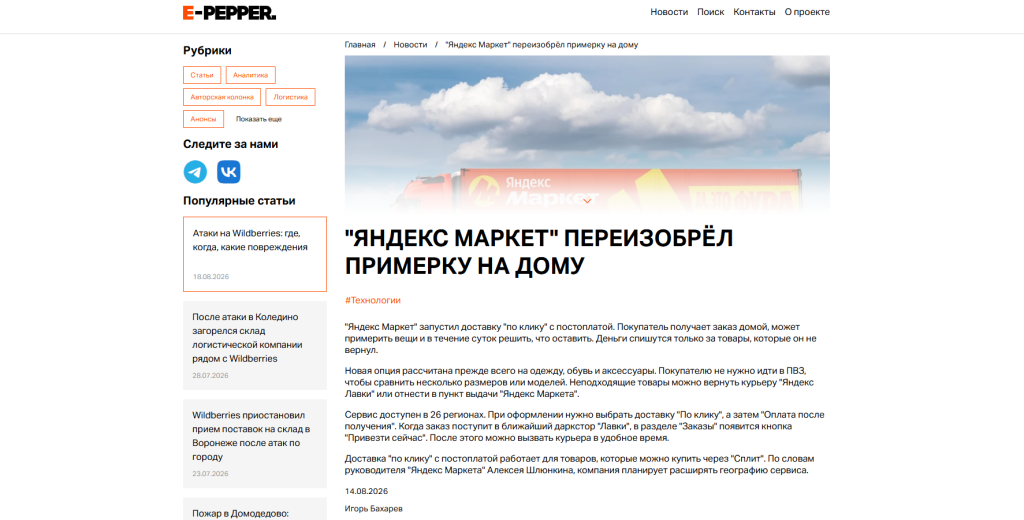
Eligible clothing, footwear and accessories can now be delivered straight to shoppers‘ homes. Customers try items on and decide what to keep, paying only for the products they retain. Unwanted goods may be collected by Yandex Lavka couriers or dropped off at platform pick-up points. The service is already live across 26 Russian regions, with further geographic expansion planned.
This points to a notable shift in Russian apparel consumption: consumers face lower trial-and-error costs. By offering a more convenient shopping experience, the platform aims to convert hesitant demand held back by sizing and fit concerns into completed orders.
How Does Yandex Market’s Try-On-Before-Payment Service Work?
The service applies to eligible clothing, footwear and accessories. Once customers place an order, items are shipped to their homes for physical inspection and in-home try-on. Under current platform rules, buyers must make their retention decision by 23:59 on the day following delivery. They only pay for kept goods; unwanted items are either picked up by couriers or returned to pick-up points.
The feature also works alongside Yandex Split instalment payments. After confirming which items they wish to keep, shoppers may opt for Split instalments if order-level criteria are satisfied, though not all products support this combination.
From the consumer perspective, the core change is straightforward. Previously, buyers had to judge fit and appearance before paying. Now they evaluate physical goods before committing to purchase. For foreign-trade sellers, the delivery mechanism itself is less important than the ongoing shift in how Russian shoppers make buying decisions for apparel and footwear.
What Shifts Are Taking Place in Russian Apparel Consumption?
Apparel and footwear returns are already common across Russia’s e-commerce landscape. Citing Yandex’s new offering, fashion industry media PROfashion reports return rates for clothing and shoes in Russia range from 30% to 45%, with roughly 40% of returns caused by poor fit. These figures illustrate exactly why Yandex is lowering barriers to in-home try-ons.
Many consumers hold purchasing intentions yet hesitate due to the hassle of returning mis-sized items. For coats, footwear and coordinated sets especially, photos and written descriptions can hardly replicate real-life fit. A share of potential orders gets lost at this stage. By letting customers receive goods before committing to pay, part of the purchasing risk moves from pre-order to post-delivery. This can drive conversions among hesitant shoppers for the platform and unlock conversion opportunities for foreign-trade sellers.
Sellers should not assume that participating in the service automatically improves organic search ranking. No public data confirms boosted search weighting for enrolled listings. A practical approach is to monitor changes in click-through rate, conversion rate, final close rate and return rate after activation. Higher order volume means little if final conversion stays flat and return-related costs rise substantially.
For Foreign-Trade Sellers: New Opportunities Alongside Rising Return-Related Costs

Not all apparel-footwear SKUs should be enrolled wholesale immediately. Products with consistent sizing, stable patterns and clear descriptive attributes make better test candidates, such as basic-style garments, sneakers and casual shoes. Fit is easier for end-users to assess, and return risk remains more manageable. Sellers need to exercise greater caution with items featuring unconventional cuts, inconsistent sizing, prominent color deviation, or designs vulnerable to damage during home try-ons.
Profit margin is another critical consideration. While try-on-before-payment may lift order volumes, it can also generate more returns, re-processing work and inventory occupancy. Low-margin products risk having profits erased by even a single returned unit. Sellers should calculate full fulfilment costs rather than merely subtracting procurement cost from selling price. Additional cost items include last-mile delivery, return handling, capital tied up in inventory, and write-offs for returned goods that cannot be resold.
Yandex has not released a unified return-fee schedule for this specific service, so fixed per-item return-cost assumptions do not apply. Foreign-trade sellers need to calculate real-world costs based on their own fulfilment setup.
Sellers operating Russian-based warehouses, local stock and mature return-processing channels enjoy faster inspection, restocking and resale of returned goods, easing cash-flow pressure. Without local return infrastructure, longer transit and reprocessing cycles amplify inventory and cash-flow strain. A prudent roll-out strategy avoids full-store activation. Instead, test select SKUs with healthy margins, controllable return risk, suitability for home try-on and viable local fulfilment support.
How Foreign-Trade Sellers Can Capitalize on Emerging Russian Apparel-Footwear Opportunities
Existing sellers active in Russia can cherry-pick suitable SKUs from their current catalogue. For sellers yet to launch large-scale Russian operations, however, market validation should come first.
Russia is geographically diverse, with regional variation in climate, consumer habits and product demand. Winter coats and insulated footwear, for instance, are heavily climate-dependent. Rather than overstocking upfront, research local search trends, prevailing price brackets and competitor best-selling lines.
To examine cross-regional market differences, NovProxy’s multi-region IP resources support research work. Sellers can inspect geographically-specific search outputs, product pages and competitor listings. Understanding market demand before committing inventory mitigates the risk of overstocking items with weak local appeal.
Localised product listings are equally important. Size charts should go beyond generic S/M/L or Russian sizing codes. Add reference inputs such as height, weight, bust, waist and foot length to help shoppers self-assess fit. Product images should reflect real-world wearing effects. Explicitly document garment thickness, material stretch, cut, as well as shoe width and sole thickness. Accurate Russian-language product information reduces mis-purchases stemming from language gaps.
These optimisations serve more than click generation: they narrow expectation-reality gaps for buyers. Try-on-before-payment lowers purchase friction, yet inaccurate product information will still drive higher return volumes.
Run small-scale tests on selected SKUs and track four core metrics: conversion rate, final close rate, return rate and net profit per unit. Scale up SKUs where higher order volumes coincide with improved final conversion and acceptable return-related expenses. If order growth stems mostly from multi-size / multi-colour ordering without corresponding final sales gains, revisit product specifications, size documentation and margin structures. For sellers entering Russia for the first time, market research and listing localisation form the starting point. Validate end-to-end performance with a small test batch before heavy inventory investment.

Russia’s Apparel-Footwear E-Commerce Enters a New Competitive Phase
The timing of Yandex’s launch merits attention. During 2026 major Russian marketplaces have adjusted return and fulfilment rules. In May, local media reported Wildberries and Ozon might introduce 50-200-ruble fees for certain returns. Platforms later issued clarifications, so sellers should not treat universal new return-fee policies as confirmed fact.
Instead of fixating on isolated platform fee announcements, foreign-trade sellers should observe the broader industry shift: Russian e-commerce is balancing consumer convenience, return-related expenses and platform operational efficiency. Yandex’s try-on-before-payment lowers psychological purchasing barriers to capture more demand. As shoppers grow more mindful of the consequences of buying mis-fit goods, platforms mitigating consumer trial risk will attract greater user attention.
This sends a clear signal to foreign-trade sellers: Russian apparel-footwear competition will no longer revolve around price alone. Product clarity, transparent sizing, margins covering return overheads and capable local fulfilment will grow in importance. New-market entrants should prioritise SKUs with well-defined product specifications, intuitive sizing frameworks, sufficient profit buffers and feasible local warehousing and after-sales support.
Closing Thoughts
On the surface, Yandex Market’s try-on-before-payment service revises delivery and payment workflows for apparel-footwear goods. Fundamentally, it lowers consumers‘ risk of buying clothing and shoes online. For foreign-trade sellers, it brings potential conversion gains alongside elevated return-handling and inventory-management pressures.
Avoid chasing raw order-volume growth blindly. Test appropriate SKUs and use real-world final-conversion, return-rate and profit data to guide scaling decisions.
As service coverage expands, Russian shopping habits may gradually shift from “cautious pre-payment ordering” toward “receive-first-decide-later”. For foreign-trade sellers, the key is not merely tracking a new Yandex feature. It is understanding evolving Russian consumer behaviour and assessing whether your product portfolio can adapt to those changes.